Summary
Unveiling the Robotic Revolution in Transportation: Transforming Driverless Rides with Waymo, Tesla, and Uber
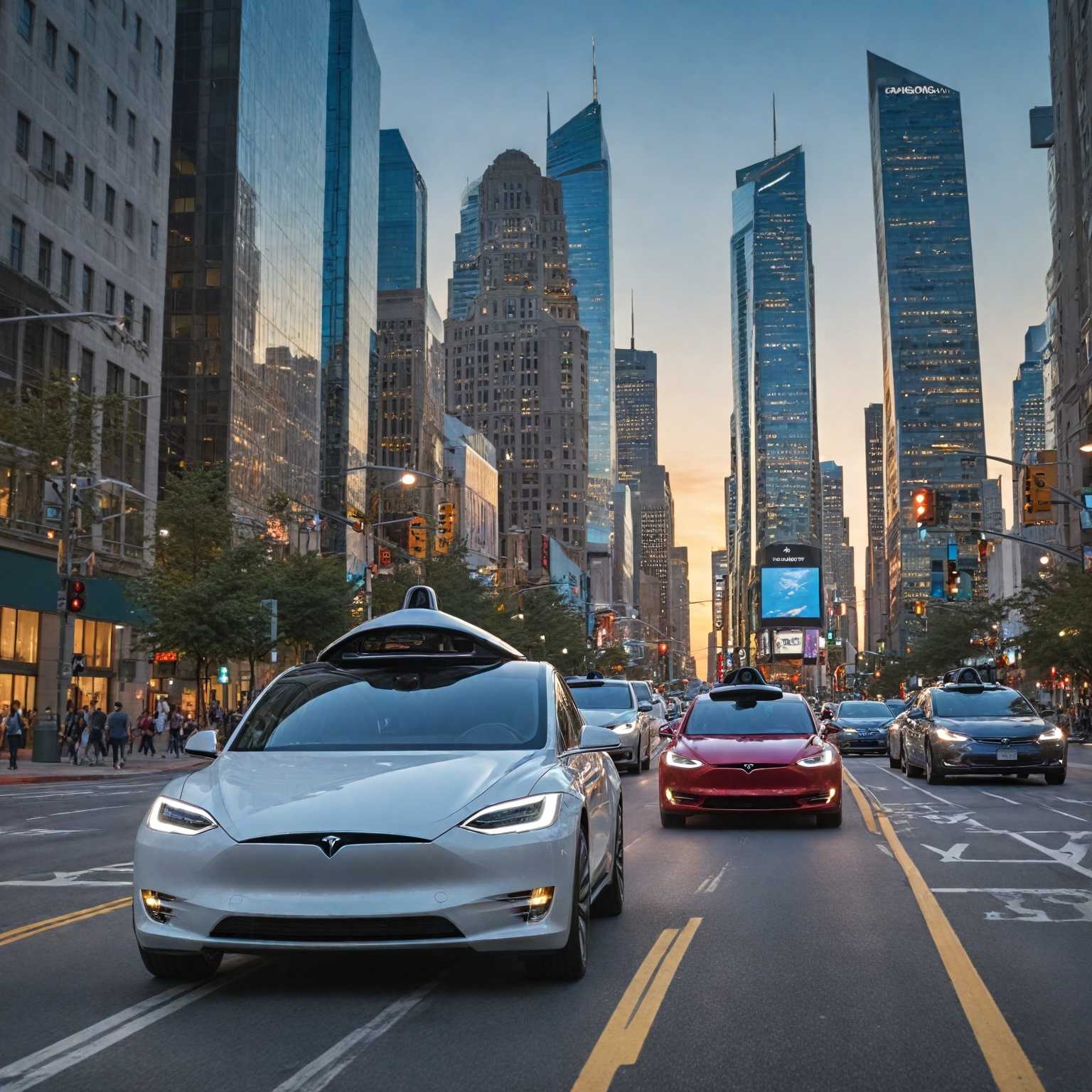
Autonomous vehicles, once a futuristic concept, have rapidly evolved into a transformative force reshaping the transportation industry. Pioneered by companies such as Waymo, Tesla, and Uber, driverless rides are advancing through sophisticated integration of artificial intelligence, sensor technology, and extensive real-world testing. These innovations promise to improve road safety, increase accessibility, and redefine urban mobility by reducing reliance on human drivers while fostering new business models in ride-hailing and freight logistics.
Waymo, a subsidiary of Alphabet Inc., leads with fully autonomous ride-hailing services utilizing advanced sensor suites including lidar, radar, and cameras, enabling precise environmental perception and decision-making. Tesla adopts a distinct approach centered on computer vision with an all-camera system, continuously enhancing its Full Self-Driving software via over-the-air updates and leveraging its extensive fleet data to refine autonomous capabilities. Uber complements this landscape by integrating autonomous vehicles into its existing platform through partnerships and fleet management, expanding access to driverless rides in select cities while navigating complex operational and regulatory environments.
Despite promising technological strides, the autonomous vehicle sector faces significant challenges including regulatory fragmentation, safety concerns, and ethical questions about liability and decision-making in automated systems. Notable controversies have emerged, such as high-profile legal disputes between Waymo and Uber over intellectual property, and incidents involving accidents and pedestrian safety that have prompted regulatory scrutiny and operational suspensions. These events underscore the delicate balance between innovation, public trust, and governance as driverless technology moves toward broader adoption.
Looking ahead, the robotic revolution in transportation is poised to redefine mobility through ongoing technological innovation and evolving business strategies. However, its success depends on harmonizing safety standards, regulatory frameworks, and societal acceptance to fully realize benefits such as improved traffic efficiency, enhanced accessibility for disabled populations, and reduced environmental impact. The interplay between pioneering companies like Waymo, Tesla, and Uber will continue to shape the future trajectory of autonomous transportation worldwide.
History of Robotic Transportation
The concept of driverless vehicles dates back nearly a century, with early prototypes emerging as far back as the 1920s. These initial models, such as the Houdina Radio Control car from 1925, were not fully autonomous by modern standards but relied heavily on external inputs like radio signals, often controlled by a second vehicle following closely behind. Throughout the mid-20th century, research into electronic roadways and “drive-by-wire” systems advanced the field, exemplified by trials in the UK during the 1960s where autonomous cars reached speeds up to 130 km/h on specially designed tracks, demonstrating steadier driving performance than humans and projecting the potential to prevent a significant portion of road accidents.
Significant progress was made with the development of specialized autonomous systems, including the Stanford Cart project in the late 1970s. Initially conceived as a moon rover project, it pioneered the use of video processing technology to enable navigation around obstacles without human intervention. The cart’s ability to autonomously cross a room crowded with chairs over several hours marked a crucial step in unmanned navigation research. These early efforts laid the groundwork for the convergence of technologies that would later enable modern autonomous vehicles.
The modern era of robotic transportation gained momentum with major investments from technology companies in the 2000s. Google’s Project Chauffeur was a landmark, conducting the first fully autonomous trip on public roads without a test driver or police escort and featuring a vehicle devoid of traditional controls such as steering wheels or pedals. By the end of 2015, the project had logged over a million miles of autonomous driving, backed by an investment exceeding $1 billion from 2009 to 2015. In comparison, automotive industry moves such as General Motors’ acquisition of Cruise Automation in 2016 for $500 million and Uber’s purchase of Otto for $680 million reflected increasing commercial interest and consolidation in the sector.
Autonomous taxis became a reality in the late 2010s and early 2020s, with companies like Waymo, Cruise, and Uber deploying pilot programs in select cities. Notably, in February 2022, Cruise launched driverless taxi rides to the public in San Francisco, marking a major milestone in commercial robotaxi services. However, this period was also marked by setbacks; incidents such as a Cruise vehicle striking and dragging a pedestrian led to regulatory action, including the California DMV revoking Cruise’s license to operate in 2023 due to safety concerns. Subsequently, Cruise suspended its robotaxi service nationwide, though it resumed supervised testing in other cities. Meanwhile, Waymo continued operations in San Francisco, albeit with some incidents, including a collision involving a bicycle in early 2024.
Alongside commercial deployments, the broader development of autonomous driving technologies has involved extensive simulation and testing to address complex real-world scenarios. Companies have driven billions of miles in simulation environments to refine their software and improve safety. The progress is complemented by ongoing legislative efforts worldwide to create harmonized regulatory frameworks that facilitate the safe integration of autonomous vehicles into public roadways, acknowledging their potential contributions to sustainable development.
Despite challenges, the history of robotic transportation reflects a persistent trajectory of innovation, from early experimental vehicles to advanced robotaxis poised to transform urban mobility. This evolving landscape continues to balance technological breakthroughs with safety, regulatory, and societal considerations.
Key Players in the Robotic Transportation Industry
The robotic transportation industry is driven by several prominent companies pioneering autonomous vehicle technology, with Waymo, Tesla, and Uber being key players shaping the future of driverless rides.
Waymo
Waymo LLC, a subsidiary of Alphabet Inc., originated from the Google Self-Driving Car Project and is headquartered in Mountain View, California. The company’s mission is to make transportation safe and accessible by deploying fully autonomous vehicles integrated with cutting-edge technology. Waymo has launched the world’s first commercial autonomous ride-hailing service, utilizing the Chrysler Pacifica Hybrid minivan—its first mass-production vehicle platform specifically designed for the Waymo Driver system. The company’s hardware includes a fifth-generation sensor suite featuring one of the world’s first imaging radar systems that provides high-resolution, long-range, and wide field-of-view sensing capabilities to perceive the environment comprehensively.
Waymo extensively employs advanced artificial intelligence, including neural networks and transformer architectures originally developed for large language models, to enhance its perception and predictive capabilities, enabling its vehicles to identify, track, and anticipate the actions of surrounding objects and vehicles. The company collaborates with automotive partners to deploy autonomous vehicles on various platforms and expand access to riders in different cities, often working closely with local governments to support deployment.
Tesla
Tesla, headquartered in Austin, Texas, is a major player in the autonomous vehicle space, leveraging its deep expertise in electric vehicle manufacturing and software innovation. The company is well-known for integrating advanced driver-assistance systems into its electric cars, aiming to achieve full self-driving capabilities. Tesla’s approach to innovation is driven by ambitious goals, such as transitioning the world to sustainable energy and pioneering autonomous technologies that push the boundaries of transportation. While Tesla has sought regulatory approvals to offer ride-hailing services and expand its autonomous driving capabilities, its developments have also sparked competition in key testing regions like Texas and California.
Uber
Uber has actively pursued autonomous vehicle technology as part of its broader strategy to innovate ride-hailing services. In collaboration with Waymo, Uber offers driverless rides in cities such as Austin, Texas, and Phoenix, Arizona, providing users with the option to select autonomous vehicles when booking rides through its platform. Uber previously operated its own autonomous vehicle fleet before divesting it to Aurora but continues to pilot and scale autonomous vehicle programs in major metropolitan areas. These efforts depend heavily on supportive local governments and consumer willingness, which are essential to bring driverless services to market successfully.
Industry Challenges and Collaboration
Despite the advancements made by these companies, the industry faces challenges related to inconsistent regulatory frameworks, particularly in the United States, where federal and state regulations for autonomous vehicles vary significantly. This regulatory fragmentation complicates efforts to deploy autonomous fleets on a wide scale. Companies like Waymo and Volvo Autonomous Solutions emphasize the need for regulatory consistency to fully realize the benefits of autonomous transportation and foresee a future where human drivers and autonomous vehicles coexist on the roads.
Technology Behind Driverless Rides
Driverless rides rely on a sophisticated integration of hardware and software systems that enable vehicles to perceive their environment, make decisions, and navigate safely without human intervention. Central to this technology are three key categories of hardware: sensors, computing units, and embedded control systems. Sensors gather detailed information about the vehicle’s surroundings, which is then processed by onboard computing systems to interpret data and make driving decisions. Finally, embedded control systems execute actions such as steering, braking, and acceleration based on the computed instructions.
Waymo, a leading autonomous vehicle company, employs an advanced sensor suite comprising LiDAR, radar, and cameras to achieve comprehensive environmental perception. Its fifth-generation hardware includes one of the world’s first imaging radar systems, providing unparalleled resolution, range, and a 360-degree field of view. This enables Waymo’s vehicles to detect small objects at great distances and maintain awareness in diverse lighting and weather conditions. The LiDAR system specifically generates high-resolution three-dimensional maps of the surroundings by emitting millions of laser pulses and measuring their reflections, allowing precise distance measurement and object differentiation—such as distinguishing a pedestrian from a static image. Cameras in Waymo’s fleet are designed with high dynamic range and thermal stability, supporting 360-degree vision to identify traffic lights, construction zones, and other crucial elements hundreds of meters away, even in low-light conditions.
Tesla’s approach to driverless technology differs significantly by relying primarily on cameras and computer vision, eschewing LiDAR entirely. Tesla vehicles are equipped with multiple exterior cameras providing 360-degree visibility, and use deep learning algorithms, particularly convolutional neural networks (CNNs), to interpret visual data and make driving decisions. Tesla’s system, known as Full Self-Driving (FSD), employs a custom-designed “FSD Chip” and has progressively transitioned to an all-visual sensor suite by dropping radar and ultrasonic sensors. This camera-centric approach allows Tesla to leverage its large fleet to collect vast amounts of driving data, which is used to train its AI models through machine learning techniques.
Both Waymo and Tesla utilize artificial intelligence to process sensor data and execute autonomous driving tasks, but their strategies diverge in sensor reliance and software design. Waymo combines detailed high-definition maps with real-time sensor input to localize its vehicles and make driving decisions that are generalized across various environments. In contrast, Tesla’s system emphasizes a generalized AI model that adapts to diverse scenarios based solely on visual input without the use of pre-built maps, aiming to replicate human driving behavior through sight alone.
The fusion of sensor technologies with AI-driven perception and control systems forms the backbone of current driverless rides, enabling vehicles to navigate complex environments safely. However, the evolving sophistication of these technologies also raises questions regarding ethical responsibility and accountability, as AI systems increasingly take control of decision-making processes traditionally handled by human drivers.
Business Strategies and Evolution
The development and deployment of autonomous vehicle technologies by Waymo, Tesla, and Uber demonstrate distinct business strategies shaped by their core competencies and market approaches. Each company’s evolution reflects different priorities in technology integration, partnerships, and regulatory navigation, collectively advancing the driverless ride industry.
Waymo: Pioneering Autonomous Ride-Hailing through Strategic Partnerships and Expansion
Waymo’s strategy centers on building a fully integrated autonomous ride-hailing service, leveraging a combination of hardware, software, and extensive simulation to ensure safety and reliability. Established under Alphabet, Waymo began public trials in Arizona’s Metro Phoenix area, engaging local residents to refine its technology and customer experience. The company expanded its service footprint through a Silicon Valley rollout and collaborations with Uber, allowing riders to hail Waymo’s autonomous vehicles via the Uber app in cities like Austin.
In early 2025, Waymo and Uber announced an expanded partnership to bring fully autonomous, all-electric Jaguar I-PACE vehicles to Austin and Atlanta, with Uber managing fleet operations such as cleaning and repairs, while Waymo maintains responsibility for vehicle testing and operation. This collaborative model illustrates Waymo’s approach to scaling autonomous ride-hailing by combining technological leadership with operational partnerships. Additionally, Waymo’s manufacturing strategy evolved from custom vehicle designs to retrofitting existing models like the Jaguar I-PACE and Chrysler Pacifica Hybrid, optimizing production efficiency and market readiness.
Tesla: Incremental Autonomy through Software-Centric Innovation and Consumer Engagement
Tesla’s business strategy focuses on advancing driver-assistance technologies through continual software development and direct consumer integration. Tesla Autopilot, introduced in 2014, began as an advanced driver-assistance system (ADAS) with features such as automatic parking and low-speed summoning, gradually evolving to include autosteer and traffic-aware cruise control across all vehicles produced after April 2019. Tesla markets an optional “Full Self-Driving (Supervised)” package, adding semi-autonomous navigation and other driver-assistance capabilities, although full vehicle autonomy remains a future goal dependent on software advancements and regulatory approval.
Distinct from competitors like Waymo, Tesla relies primarily on an all-camera sensor suite rather than lidar or highly detailed 3D maps, emphasizing scalable software updates delivered over-the-air to continuously enhance vehicle capabilities. Tesla’s approach also involves managing consumer expectations and regulatory scrutiny, responding to concerns about the Autopilot name implying full autonomy despite current Level 2 automation status. Elon Musk’s vision underscores software as the key to unlocking full autonomy, leveraging the existing hardware platform as a foundation for future developments.
Uber: Integrating Autonomous Technology through Collaboration and Service Expansion
Uber’s strategy focuses on integrating autonomous driving technologies into its existing ride-hailing platform through strategic partnerships, most notably with Waymo. Faced with legal challenges and the need to maintain competitive advantage in autonomous vehicle development, Uber entered into agreements that prevented the use of Waymo’s proprietary technology while fostering cooperative deployments. Uber’s partnership with Waymo allows it to expand autonomous ride-hailing offerings in new markets, managing fleet operations while relying on Waymo’s driver technology.
This collaborative approach enables Uber to leverage Waymo’s technological advancements to enhance its service portfolio without independently developing full self-driving technology from scratch. Uber’s commitment to fleet management and operational support in cities like Austin and Atlanta illustrates its role as a service provider, facilitating broader access to autonomous rides within its app ecosystem. By embedding autonomous vehicles within its platform, Uber aims to future-proof its business model amid the growing driverless transportation landscape.
Common Threads and Industry Impact
All three companies emphasize the importance of proof-of-concept demonstrations and iterative improvements to drive market adoption. Tesla’s software-driven enhancements, Waymo’s extensive simulation-based testing and real-world trials, and Uber’s integration of autonomous fleets through partnerships highlight varied but complementary approaches. These strategies collectively contribute to the accelerating evolution of driverless rides, setting new standards for safety, user experience, and operational scalability.
The industry’s future hinges on overcoming technological challenges, regulatory hurdles, and public acceptance, with these companies playing pivotal roles in shaping the trajectory of autonomous transportation. Their evolving business models underscore a shift from isolated technological innovation to integrated service delivery, paving the way for a robotic revolution in transportation.
Impact on Society and Transportation
Autonomous vehicle technology holds significant promise to revolutionize the transportation industry by enhancing efficiency in the global supply chain, addressing driver shortages, and meeting increasing freight demands. Despite these anticipated benefits, public reactions remain mixed, with varying levels of acceptance and concern regarding the integration of driverless vehicles into everyday life. Surveys indicate that while a notable portion of consumers express willingness to use or purchase autonomous cars, this interest decreases when additional costs are involved or uncertainties about the technology persist.
One major societal impact of autonomous vehicles is the potential to improve road safety. Companies like Waymo emphasize that their platforms are built on highly rated, rigorously tested vehicles that prioritize crashworthiness through advanced safety features such as airbags, seat belts, and crash structures. Waymo asserts that autonomous driving technology can save lives and enhance mobility for all, addressing the unacceptable status quo of road safety today. Similarly, Tesla
Regulatory and Ethical Considerations
The regulatory landscape for autonomous vehicles remains complex and evolving, with significant variations between countries and even within jurisdictions of the same country. In the United States, for example, there is no comprehensive national framework governing the deployment and operation of autonomous vehicles. Instead, regulatory authority is fragmented among federal, state, and local governments, creating challenges for companies seeking to commercialize this technology.
At the federal level, legislative efforts such as the 2017 SELF DRIVE Act aimed to accelerate the adoption of self-driving cars by preempting state-level performance standards and requiring safety assessments from manufacturers. However, complementary bills like AV START stalled due to concerns about insufficient provisions addressing safety and liability. Meanwhile, state laws vary widely: Nevada, for instance, was among the first to legalize autonomous vehicles in 2011 and conducted early tests of Google’s driverless technology in 2012. California, a hub for autonomous vehicle development, has seen ongoing debates over the balance of control between state and local authorities, exemplified by the recent passage of SB 915, which seeks to restore some local regulatory powers without hindering the safe operation of autonomous services. The tension between state and local regulation reflects broader uncertainties about responsibility and oversight as autonomous technologies become more prevalent.
Internationally, countries like Germany and Israel are working to finalize legal frameworks to clarify liability, operational permissions, and safety standards in accordance with international agreements such as the Vienna Convention on Road Traffic. These efforts underscore the global nature of the regulatory challenge, which must reconcile rapid technological innovation with public safety, privacy, and ethical considerations.
Ethical and legal questions arise when control shifts from human drivers to automated systems. This transfer necessitates clear frameworks for consent, operational responsibility, and liability. Existing laws may need to evolve to fairly attribute responsibility among vehicle occupants, system operators, insurers, and public authorities in the event of accidents or damage. For example, Waymo’s extensive data on crashes and safety incidents highlights the importance of transparent reporting balanced against protecting proprietary information, as seen in Waymo’s legal actions to keep certain crash data confidential, citing trade secret concerns.
The competitive landscape among autonomous vehicle developers has also sparked significant legal disputes, illustrating the high stakes involved. The protracted litigation between Waymo and Uber over alleged theft of trade secrets centered on the misappropriation of proprietary lidar technology by a former Waymo engineer who later joined Uber. The settlement included restrictions on Uber’s use of Waymo’s confidential information and underscored the intense rivalry and legal complexity within the industry.
Additionally, rideshare companies like Uber face ethical scrutiny beyond autonomous technology, including issues related to worker classification and passenger safety. The 2023 California appeals court decision upholding Proposition 22 allowed Uber to classify drivers as independent contractors, impacting labor rights. Meanwhile, the consolidation of multiple sexual assault claims into multidistrict litigation highlights ongoing concerns about rider safety in app-based transportation services.
Tesla, another key player in the autonomous vehicle revolution, integrates active safety features as standard on vehicles produced since 2014, leveraging hardware and software systems such as Autopilot to enhance protection. Tesla’s recent moves toward offering ride-hailing services further emphasize the growing intersection between autonomous technology, regulatory oversight, and commercial deployment.
Legal Challenges and Industry Implications
The advancement of autonomous vehicle technology has brought about significant legal challenges and industry-wide implications, particularly involving major players such as Uber and Waymo. One of the most notable legal disputes was the high-profile trade secret lawsuit filed by Waymo against Uber. Central to the case was Anthony Levandowski, a former Waymo technical lead and co-founder, who was accused of stealing proprietary information related to self-driving car technology. The lawsuit primarily focused on the hardware components of Waymo’s lidar technology, with a separate trial on software alleged theft planned for a later date. After an intense and widely publicized litigation process, which revealed controversial details such as deleted text messages and corporate strategies, the parties reached a surprising settlement just five days into the trial. Uber agreed to pay Waymo approximately $245 million in equity, representing 0.34 percent of Uber’s shares, and committed to a legally binding agreement not to use Waymo’s confidential hardware or software intellectual property in its own autonomous vehicle systems.
This settlement not only resolved a potentially crippling legal battle for Uber but also underscored the competitive and sometimes contentious nature of the emerging autonomous vehicle industry. The case highlighted the fierce “battle for founder status” and market dominance in the sector, while the equity stake in Uber ensured Waymo’s continued interest in the company’s success. Uber’s acknowledgment of the need to develop autonomous technology to remain competitive further emphasizes the strategic importance of driverless vehicles in the ride-hailing market.
Aside from intellectual property disputes, the industry faces broader legal and regulatory challenges, particularly in defining liability and operational responsibility as control shifts from human drivers to automated systems. The deployment of automated vehicles necessitates new legal frameworks to address issues such as consent to share driving responsibility, liability allocation among occupants, system operators, insurers, and potential conflicts involving public funds. The Organisation for Economic Co-operation and Development (OECD) markets anticipate accelerated adoption of autonomous vehicles, prompting regulatory bodies to focus on harmonizing safety standards, legal responsibility, and privacy concerns with public expectations.
In parallel, regulatory developments at the state level continue to evolve. For example, in California, the Public Utilities Commission (PUC) extended permission for Waymo to operate on highways despite local objections. The ongoing legislative process aims to balance state and local authority over autonomous vehicle operations. In May 2024, the California State Senate passed Senate Bill 915 (SB 915), which attempts to restore some local control while preventing local governments from blocking the safe deployment of autonomous vehicle services. The bill’s final approval was pending as of mid-2024, reflecting the dynamic and sometimes contentious regulatory environment surrounding driverless cars.
Additionally, Uber has faced legal scrutiny unrelated to intellectual property, notably concerning labor classification and rider safety. In 2023, a California appeals court upheld Proposition 22, which allows Uber and other rideshare companies to classify their drivers as independent contractors rather than employees, affecting drivers’ rights and benefits. Concurrently, Uber is confronting numerous sexual assault claims filed by passengers, with a federal judge in California consolidating around 80 cases into multidistrict litigation (MDL) to manage the complex proceedings.
Together, these legal challenges and regulatory developments illustrate the multifaceted and evolving landscape of the autonomous vehicle industry. They highlight the delicate balance between fostering innovation, ensuring public safety, protecting intellectual property, and addressing social and legal responsibilities as the robotic revolution in transportation continues to transform driverless rides.
Future Prospects and Innovations
The future of driverless rides and autonomous transportation is poised for transformative advancements driven by continuous innovation and expanding regulatory frameworks. Industry leaders such as Tesla, Waymo, and Uber are pushing the boundaries of technology while navigating complex legislative landscapes to bring autonomous vehicles (AVs) into mainstream use.
Tesla’s future prospects hinge on ambitious goals inspired by its visionary leadership, aiming not only to revolutionize transportation but also to contribute to sustainable energy and space colonization initiatives. Tesla continues to develop cutting-edge technologies, including a fifth-generation hardware sensor suite featuring an advanced imaging radar system that offers unparalleled resolution, range, and field of view for comprehensive environmental awareness. Its evolution from the initial Advanced Driver-Assistance Systems (ADAS) using Mobileye hardware to the integration of Nvidia Drive PX 2 computers and enhanced camera arrays highlights Tesla’s commitment to iterative technological refinement. These advancements underpin Tesla’s strategic direction to push the boundaries of autonomous driving capabilities, ultimately striving for fully autonomous vehicles that can safely navigate diverse road conditions without human intervention.
Waymo remains a frontrunner in deploying fully autonomous rides to the public, exemplified by its early introduction of driverless taxi services in San Francisco. Its partnership approach, collaborating with cities and platforms to broaden accessibility, illustrates the model for scaling autonomous ride services. However, the economic viability and demand disparities between affluent urban centers and less wealthy areas pose challenges, potentially exacerbating social divides in mobility access. Despite these challenges, Waymo’s continued investment in AI-driven perception and decision-making systems positions it to maintain leadership in safe and efficient autonomous transportation.
Uber’s foray into the driverless market is characterized by pragmatic scaling efforts in select cities such as Phoenix, Austin, and Atlanta, where it plans to expand its fleet to hundreds of autonomous vehicles over the coming years. This phased approach, supported by local government cooperation and consumer willingness, is critical for integrating autonomous services within existing urban transit ecosystems. Additionally, the upholding of California’s Proposition 22 ensures flexible labor models that may influence how autonomous and human-driven services coexist and evolve.
Beyond individual company innovations, the broader transportation industry anticipates significant impacts from autonomy, including improved supply chain efficiency, mitigation of driver shortages, and enhanced freight logistics. However, public acceptance and regulatory harmonization remain key hurdles. In the United States and internationally, efforts are underway to develop consistent regulatory frameworks that facilitate safe deployment and address legislative issues related to autonomous vehicle trials and usage. This regulatory evolution is essential to balance innovation with safety, ethics, and public trust.
The content is provided by Jordan Fields, Gear Shift Zone