Summary
The Perodua QV-E is the first electric vehicle (EV) model developed and produced by Perodua, Malaysia’s second national car manufacturer. Officially trademarked in March 2025, the QV-E represents a significant milestone in Perodua’s strategic shift towards sustainable mobility and green technology, aligning with Malaysia’s national ambitions under the New Industrial Master Plan 2030 to become a regional EV hub. Unlike previous models developed in collaboration with Japanese partners, the QV-E is built on a bespoke EV platform designed entirely in-house, marking a bold departure from Perodua’s traditional reliance on external technical assistance.
The vehicle was publicly unveiled as a half-cut prototype at the Malaysia Auto Show 2025, showcasing Perodua’s engineering capabilities and commitment to innovation. Technical specifications suggest that the QV-E will feature a lithium iron phosphate (LFP) battery with an estimated range of approximately 400 to 410 kilometers, advanced safety systems such as Blind Spot Monitoring and Rear Cross Traffic Alert, and modern charging solutions including Battery-as-a-Service (BaaS). Pricing is anticipated to be competitive within the RM50,000 to RM90,000 range, positioning the QV-E as one of the most affordable EVs in the Malaysian market upon its planned launch in late 2025.
The QV-E’s trademarked logo, characterized by blue accents symbolizing electrification and environmental friendliness, reflects Perodua’s branding strategy to emphasize sustainability and technological progressiveness. This initiative complements Perodua’s broader “Smart Build” blueprint, which focuses on developing Malaysia’s automotive ecosystem through technology transfer, supplier development, and local production capabilities. However, the company faces scrutiny over the clarity of its localization strategy and the timeline for scaling production, with industry analysts calling for more concrete milestones to bolster consumer confidence.
Overall, the Perodua QV-E embodies both the opportunities and challenges of Malaysia’s transition to electric mobility. As the nation’s largest compact car manufacturer enters the EV market, the QV-E’s success will be critical in shaping the country’s automotive future, potentially influencing regional market dynamics and supporting national sustainability goals.
Background
Perodua, Malaysia’s second national car manufacturer, was established in 1993 with the aim of providing practical and affordable vehicles to Malaysians, specializing primarily in compact cars. The company’s name is derived from its official title, Perusahaan Otomobil Kedua Sdn Bhd, reflecting its position as the nation’s second automotive enterprise after Proton. From its inception, Perodua has sought to embody engineering expertise and a commitment to advanced technologies, as symbolized in its emblem which features gradient effects and shading to convey volume, speed, and progress—core values that resonate with automotive enthusiasts.
Throughout its history, Perodua has collaborated closely with Japanese partners, notably Daihatsu Motor Company, which has provided technical support, component designs, and investments to enhance the Malaysian automotive ecosystem. Daihatsu’s stake in Perodua has progressively increased since the company’s founding, and Perodua’s production has included assembling models such as the Toyota Avanza since 2004. The company’s Smart Build blueprint focuses on elevating competitiveness in the industry by developing the entire supply chain and nurturing local suppliers with technical training and technology transfer.
In recent years, Perodua has emphasized the advancement of green technologies and mobility solutions aligned with national objectives. The unveiling of Perodua’s first electric vehicle (EV), the QV-E, represents a major milestone in this direction. The QV-E is notable for being built on a bespoke EV platform developed entirely in-house without technical assistance from Daihatsu or Toyota, marking a bold shift in Perodua’s approach to vehicle design and engineering. The company showcased its EV capabilities in a half-cut model at the Malaysian Autoshow 2025, underscoring its commitment to fostering the local automotive ecosystem and contributing to nation-building through knowledge transfer. Furthermore, Perodua is exploring alternative energy technologies, including partnerships to develop thorium-based power sources, highlighting its dedication to sustainability and innovation.
Complementing its technological advancements, Perodua continues to equip its vehicles with modern safety features. Spy photos of the QV-E test unit have revealed the integration of rear-mounted sensors indicative of Blind Spot Monitoring and Rear Cross Traffic Alert systems, which align with features already available on its top-spec models. These developments illustrate Perodua’s ongoing efforts to blend affordability with advanced automotive technology to meet the evolving needs of Malaysian consumers and the regional market.
New Electric Vehicle: QV-E
Perodua has officially filed a trademark application for the name and logo of its upcoming electric vehicle (EV), designated as the QV-E, with the Intellectual Property Corporation of Malaysia (MyIPO). The application, submitted on 21 March 2025, covers classes 12 and 37, with class 12 including electric cars, EV batteries, motors, and related technologies, strongly suggesting that QV-E is set to become Perodua’s first production EV.
Interestingly, this is not Perodua’s first attempt to secure the QV-E branding. A similar submission was made in late June 2024 under the slightly different arrangement “Qve,” alongside other names such as Ace and Pacer. Of these, only Ace was officially trademarked at that time, and even then, only for class 37 and without a filed logo. The current QV-E trademark includes a distinctive logo featuring blue accents on the “Q” and the entire “E,” symbolizing electrification and environmental friendliness, which aligns with common industry practices to visually emphasize EV identity.
The QV-E name and logo trademark status was noted as “Under Formality Validation” as of 30 May 2025, indicating that the registration process is ongoing. This move coincides with Perodua’s recent public unveiling of an EV prototype in a half-cut form during the Malaysia Autoshow 2025, signaling imminent progress toward the vehicle’s launch.
Further corroboration comes from statements made by Sime Darby group CEO Datuk Jeffri Salim Davidson, revealing that Perodua’s first production EV is expected to launch in December 2025, with testing slated to begin in June of the same year. Local automotive analysts speculate the QV-E could feature an LFP battery and deliver a driving range of approximately 400 to 410 kilometers, based in part on previous concept designs like the eMO-II shown at KLIMS 2024.
Taken together, the trademark filings, design cues, and official announcements indicate that the QV-E will represent Perodua’s strategic entry into the electric vehicle market, leveraging the company’s engineering expertise and commitment to sustainable automotive technologies.
Logo Design and Branding
The Perodua QV-E logo marks a significant step in the automaker’s branding strategy as it ventures deeper into the electric vehicle (EV) market. Featuring blue accents partially on the letter ‘Q’ and fully on the letter ‘E’, the color choice aligns with the broader automotive industry’s convention of using blue to signify electrification and environmentally friendly technology. This design signals Perodua’s commitment to sustainability and innovation within its EV lineup.
Perodua’s approach to branding reflects its broader corporate philosophy of blending tradition with modernity. The original Perodua logo, updated alongside the debut of the Perodua Kembara SUV, incorporates a complex elliptical symbol with colors and shapes that subtly reference the brand’s initials—specifically, a green element shaped like a stylized “P” and an adjacent curve resembling the number “2.” The emblem’s gradient effects and three-dimensional appearance convey a sense of depth, energy, and forward momentum, encapsulating Perodua’s dedication to engineering expertise and technological progress.
The typography within the logo is deliberately crafted to evoke qualities such as purity, simplicity, and openness. Notably, the letter “O” is designed in a classic shape to avoid drawing disproportionate attention, maintaining the overall balance of the inscription. The combination of these design elements aims to instill trust and reliability among consumers, reinforcing Perodua’s standing in both domestic and international markets.
By filing trademark applications for the QV-E name and logo with Malaysia’s Intellectual Property Corporation (MyIPO), Perodua is positioning the QV-E as a flagship product in its EV expansion. The careful selection of colors and design motifs serves not only aesthetic purposes but also strategic branding goals—strengthening Perodua’s identity as a forward-thinking manufacturer committed to embracing clean energy solutions while honoring its heritage in automotive manufacturing.
Prototype Unveiling
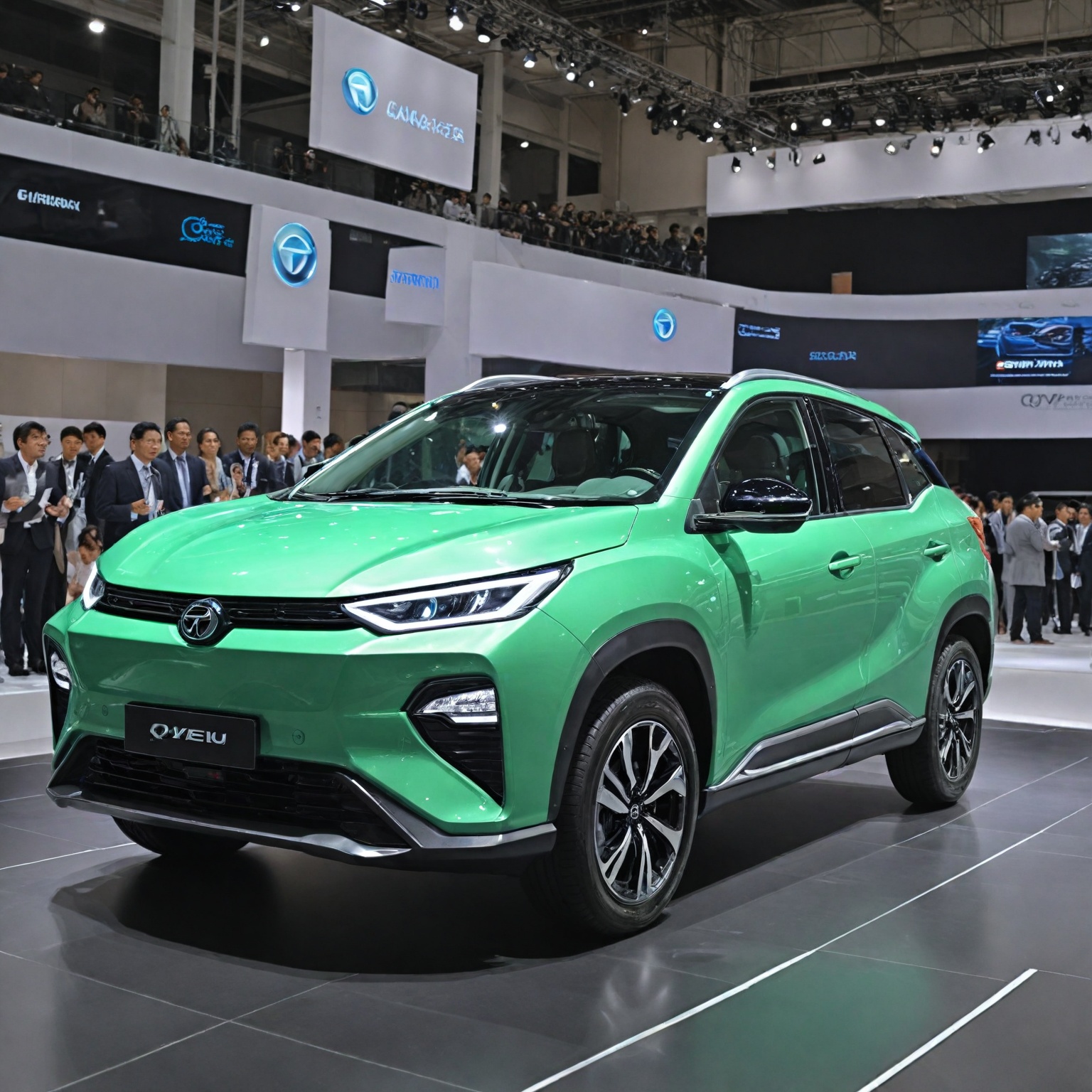
Perodua officially unveiled the final prototype of its first electric vehicle (EV) at the Malaysia Auto Show (MAS) 2025, held at MAEPS Serdang. The prototype was showcased in a half-cut form, providing a glimpse into the design and production capabilities of the upcoming model. Despite being a prototype, Perodua’s President and CEO, Dato’ Sri Zainal Abidin Ahmad, stated that the vehicle is very close to the production version that is expected to launch in the fourth quarter of 2025.
This unveiling marked the culmination of Perodua’s Electric Motion Online series, following earlier concepts such as the eMO-II shown at the Kuala Lumpur International Mobility Show (KLIMS) 2024. The design of the prototype features elements reminiscent of the eMO-II concept, notably the rear windscreen, highlighting the continuity in Perodua’s EV design language.
Although the prototype was presented without a finalized logo or official trademark for the EV’s name in class 12, Perodua had previously secured the “Ace” trademark only under class 37. The company has yet to file for the logo associated with the EV name. Testing for the production vehicle is anticipated to commence soon ahead of its planned market debut by the end of 2025.
Technical Specifications
The upcoming Perodua QV-E is designed with a lithium iron phosphate (LFP) battery sourced from CATL, offering an estimated range of approximately 400 to 410 kilometers based on the NEDC cycle. The battery capacity is around 50 kWh, enabling a 0 to 100 km/h acceleration time of under seven seconds, with a top speed reaching approximately 165 km/h.
Charging capabilities include both AC and DC fast charging options. The vehicle can be fully charged via AC in about eight hours, while DC fast charging can replenish the battery from 30% to 80% within 30 minutes, employing Combined Charging System (CCS) connectors compatible with common public charging infrastructure in the region. Perodua’s implementation of Battery-as-a-Service (BaaS) battery leasing allows for battery swaps in just 30 minutes, lowering upfront costs and ensuring battery health and maintenance are managed by the manufacturer.
In terms of safety and technology, the QV-E is expected to feature Advanced Driver Assistance Systems (ADAS) at Level 2 capability, including Blind Spot Monitoring (BSM) and Rear Cross Traffic Alert (RCTA), aligning with safety features found in Perodua’s other high-spec models. The vehicle is also designed to meet the 5-star ANCAP safety classification.
The QV-E adopts a fastback design skewed towards the lower B-segment, targeting the compact car market, with pricing anticipated to be competitive within the RM50,000 to RM90,000 range, making it one of the most affordable EVs in Malaysia once launched.
Market and Strategic Impact
Perodua’s unveiling of the QV-E electric vehicle (EV) represents a significant strategic move as the company aims to strengthen its position in the increasingly competitive Southeast Asian automotive market. Positioned as Malaysia’s largest manufacturer of compact cars and a leading regional player, Perodua is leveraging the QV-E to accelerate its transition into the EV segment, aligning with national ambitions to become a regional EV hub under the New Industrial Master Plan 2030 (NIMP 2030).
From a market perspective, Perodua’s approach to the QV-E incorporates a bold product strategy that deviates from the industry norm. Unlike many manufacturers that adopt established EV platforms, Perodua claims to be developing a bespoke EV platform entirely in-house, with intellectual property owned solely by the company and no technical support from Daihatsu or Toyota. This move highlights Perodua’s commitment to innovation and localised technological development, although it has yet to clearly define delivery milestones or localisation targets in line with national policy goals.
Strategically, Perodua’s EV initiative is nested within its broader “Perodua Smart Build” blueprint, which aims to enhance the entire Malaysian automotive ecosystem, including suppliers, dealers, and business partners. This strategy involves continuous technical training and technology transfer in partnership with Daihatsu Motor Company of Japan, fostering competitiveness and supporting Malaysia’s national automotive policy. The QV-E project exemplifies this ecosystem-centric approach by showcasing Malaysia’s capability to assimilate advanced EV technologies and contribute to the country’s green technology advancement.
In terms of market penetration, Perodua’s competitive pricing strategy, including promotional offers such as trade-in incentives, is designed to attract early adopters and overcome consumer hesitation in a market where customer awareness and engagement during advertising are challenging. The company’s positioning as Malaysia’s first and largest Energy-Efficient Vehicle (EEV) manufacturer—with over one million EEVs sold—provides a strong foundation to build consumer trust and expand its EV portfolio.
The QV-E launch also carries symbolic significance through its newly trademarked name and logo, which incorporate design elements conveying innovation, style, and technological progressiveness. This branding effort aims to reinforce Perodua’s identity as a forward-looking automaker committed to advancing green mobility solutions.
Future Prospects and Developments
Perodua’s entry into the electric vehicle (EV) market marks a significant step toward Malaysia’s ambition to become a regional EV hub, as outlined in the New Industrial Master Plan 2030 (NIMP 2030). The company is currently in the final stage of homologation for its first self-developed EV, with pilot production slated to begin between September and October 2025. Full-scale production is planned to commence at a new battery electric vehicle (BEV) plant in Sungai Choh, initially targeting a production rate of 500 units per month. This EV will feature several technological advancements for Perodua, including the first use of hot press-formed steel in one of its vehicles, highlighting the company’s commitment to incorporating innovative manufacturing techniques.
Despite these developments, there remain concerns about the clarity and execution of Perodua’s localisation strategy for the EV. While the company has made broad commitments aligning with national policies on automation, green growth, and resilient supply chains, detailed delivery key performance indicators (KPIs) have yet to be firmly established. Observers have expressed the need for Perodua to move beyond speculative announcements and demonstrate tangible progress to build consumer and stakeholder confidence in its EV initiatives.
In parallel, Perodua continues to emphasize its broader mission of developing the Malaysian automotive ecosystem through knowledge transfer and technical training. Collaborations with partners such as Daihatsu Motor Company facilitate technology transfer and supplier development under the Perodua Smart Build blueprint, which aims to enhance the competitiveness of Malaysia’s automotive industry as a whole. Additionally, Perodua has explored alternative energy sources, including partnerships with Austrian-based Emerald Horizon to develop thorium-based green technology, reflecting a forward-looking approach to sustainable mobility.
Looking ahead, Perodua’s EV launch is expected by the end of 2025, positioning the company to compete with other local players such as Proton, which plans to introduce the e.MAS 5 around the same timeframe. The success of Perodua’s EV in the competitive sub-RM100,000 segment will be closely watched as a benchmark for the maturity of Malaysia’s EV ecosystem and its readiness to embrace electrification on a broader scale.
The content is provided by Avery Redwood, Gear Shift Zone