Summary
The 2025 Volkswagen Jetta is a compact sedan that embodies Volkswagen’s strategic emphasis on innovation, efficiency, and customer-focused design within the competitive small-car segment. Representing a significant redesign, the model integrates a refreshed exterior with distinctive lighting elements and a modernized interior featuring advanced comfort and technology amenities. Notably, the 2025 Jetta continues to leverage Volkswagen’s turbocharged engine lineup, including a sportier GLI variant, while introducing enhanced chassis dynamics and expanded driver-assistance features.
Central to the 2025 Jetta’s development is Volkswagen’s interdisciplinary approach under its Strategy 2025 initiative, which prioritizes software integration, accelerated development cycles, and sustainability. This new methodology supports faster manufacturing, more frequent over-the-air software updates, and a transition toward electrification, although the Jetta itself remains powered by conventional internal combustion engines. The vehicle’s technology suite, including Volkswagen Digital Cockpit Pro, wireless connectivity, and a comprehensive suite of safety systems, underscores its alignment with evolving consumer expectations for connectivity and driver assistance.
Market-wise, the 2025 Jetta is positioned as a value-driven alternative to dominant Japanese and South Korean competitors, blending European styling and driving dynamics with a range of trim options tailored to diverse customer preferences. Volkswagen’s YourWagen marketing campaign further highlights the Jetta’s role as a reliable, stylish, and technologically advanced choice in a segment challenged by shifting consumer interest toward SUVs and electrified vehicles.
Reception of the 2025 Jetta has been generally positive, with praise for its interior comfort, technology features, and safety profile, though some critiques note that certain design elements, such as the updated grille, may polarize opinion. The model’s relevance is underscored by Volkswagen’s broader ambitions to rebuild brand trust and expand its footprint globally amid an industry transition toward sustainable mobility.
Development and Design
The development process of the 2025 VW Jetta represents a significant shift towards an interdisciplinary approach, emphasizing software integration, customer requirements, and Volkswagen’s SSP electric platform. This comprehensive redesign focuses on functions rather than individual components, enabling a reduction in development time by approximately 25%, faster software updates, and accelerated manufacturing processes. Such advancements underscore Volkswagen’s commitment to future mobility and innovation.
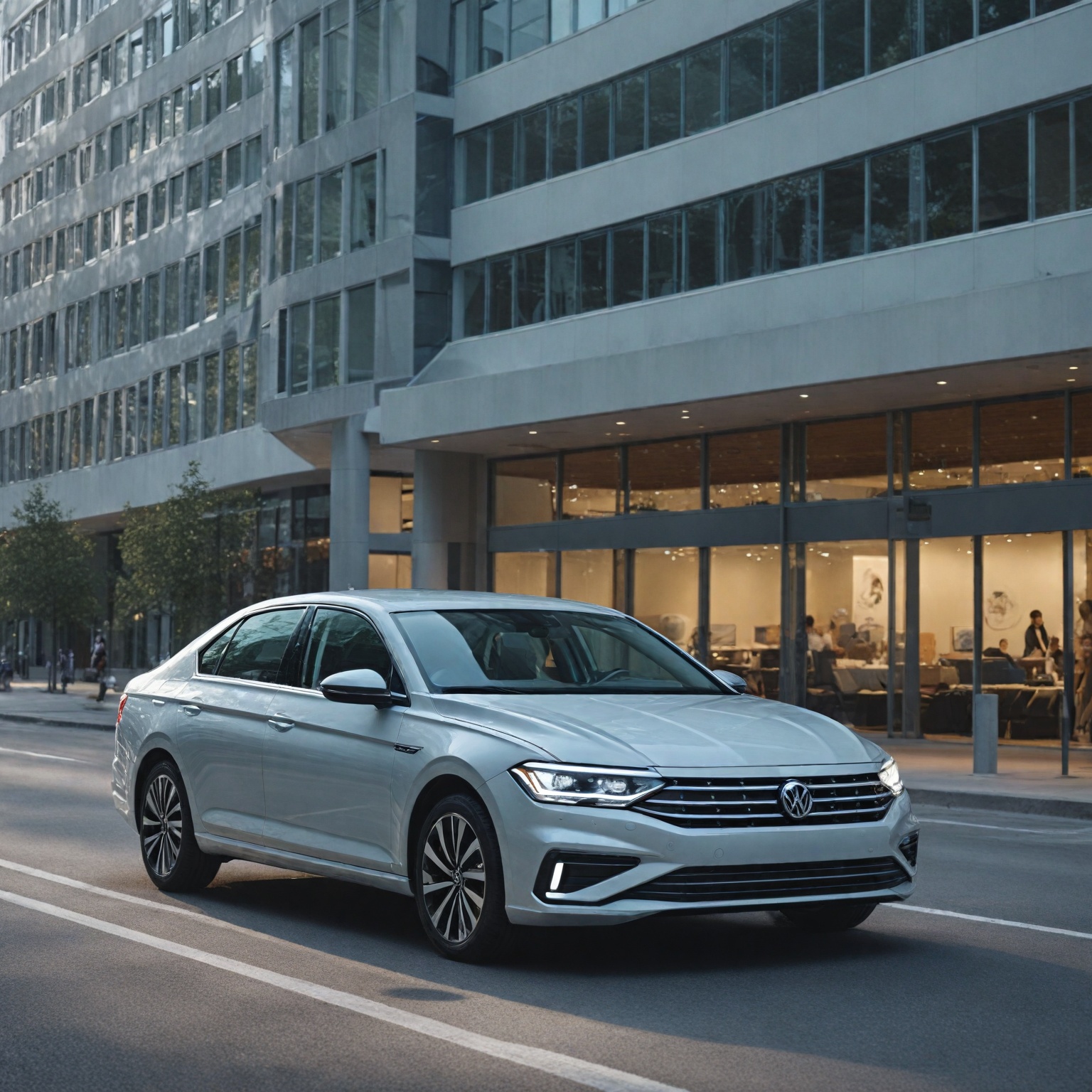
From a design perspective, the 2025 Jetta introduces a refreshed exterior featuring an all-new front and rear lighting design, including a distinctive grille and redesigned front bumper. A notable design element is the integration of the Jetta badge into the rear light bar, which, along with LED headlights and an optional front light bar on higher trims, contributes to the vehicle’s modern and dynamic appearance. The exterior updates enhance the Jetta’s aesthetic appeal, positioning it as one of the brand’s best-looking models to date.
Inside, the cabin combines comfort and versatility with a fresh palette of interior colors and materials. Available features such as power-adjustable driver’s seats with lumbar support and memory settings, heated and ventilated front seats, and heated rear outboard seats emphasize occupant comfort and convenience. Additionally, the 2025 Jetta SE and higher trims include modern amenities like a 15-watt wireless charging pad with integrated cooling and wireless App-Connect as standard, reflecting the vehicle’s blend of practicality and advanced technology.
While the redesign has been largely well-received, some critiques have pointed out that certain stylistic elements, such as the front grille’s light bar, follow contemporary trends that may not appeal universally. Nonetheless, the overall design direction reinforces the Jetta’s identity as a fun, German-engineered vehicle that balances innovation with familiar qualities.
Specifications
The 2025 Volkswagen Jetta is offered in four distinct trim levels, each tailored to deliver varying degrees of performance and style while maintaining a focus on comfort and efficiency. Under the hood, the standard powertrain features a turbocharged 1.5-liter four-cylinder TSI® engine producing 158 horsepower and 184 pound-feet of torque, paired with an eight-speed automatic transmission on all trims except the GLI, which retains the six-speed manual as an option. The Jetta GLI variant is equipped with a more powerful 228-horsepower two-liter turbocharged four-cylinder engine, underscoring its sportier positioning.
In terms of chassis and suspension, the Jetta GLI boasts a 0.6-inch lowered sport suspension with adaptive damping and a rear independent multi-link setup, contrasting with the standard Jetta’s simpler torsion beam rear suspension. Notably, for 2025, Volkswagen has introduced the GLI’s stiffer and lower suspension configuration (without adaptive dampers and independent rear suspension) to the Sport, SE, and SEL trims, enhancing handling dynamics across more models. The GLI also includes larger brakes, a front torque-sensing limited-slip differential, and progressive variable-ratio steering to further improve performance.
The 2025 Jetta emphasizes comfort and convenience inside the cabin. All trims come standard with heated front seats, with heated rear outboard seats available on the Highline trim. Power-adjustable driver seats featuring lumbar support and memory settings allow for personalized seating positions. Technological amenities include a standard eight-inch touchscreen infotainment system across all trims, wireless Apple CarPlay and Android Auto compatibility (standard on SE and SEL), and VW’s Car-Net feature that supports gesture controls such as swiping and pinch-to-zoom. Additionally, SE and higher trims offer a 15-watt wireless charging pad with integrated cooling, two USB-C ports, and a mobile hotspot option requiring a subscription.
Efficiency remains a key attribute of the 2025 Jetta, with Volkswagen’s use of lightweight materials, advanced engine management, and aerodynamic design contributing to an estimated combined fuel economy of 33 miles per gallon. Real-world testing recorded an observed fuel economy of approximately 31.8 mpg in diverse driving conditions. Volkswagen’s engineering efforts strive to balance performance, comfort, and economy, resulting in a smooth and steady driving experience characterized by solid low-end torque and easy handling, albeit without aggressive sportiness in the standard models.
Safety and driver-assistance technologies are well represented, with standard features including forward-collision warning, automated emergency braking, blind-spot monitoring, and rear cross-traffic alert. Available options include adaptive cruise control with stop-and-go functionality and lane-keeping assist. Remote Start is available on the Highline and GLI trims via the key fob or the Car-Net® app, which also provides over 20 additional connected features contingent on cellular service and software updates.
Technology and Innovation
The 2025 Volkswagen Jetta integrates advanced technology and innovative features designed to enhance connectivity, safety, and driving experience. Central to its technological suite is the Volkswagen Digital Cockpit Pro, a configurable 10.25-inch digital instrument display that allows drivers to customize the information presented on their dashboard. Complementing this is an 8-inch infotainment touchscreen that supports wireless App-Connect® with Apple CarPlay® and Android Auto™ functionality, facilitating seamless smartphone integration.
Connectivity is further expanded through Volkswagen’s Car-Net® connected vehicle services, which offer features such as service reminders, vehicle scheduling, and remote access capabilities via the myVW app. These services require cellular connectivity and a subscription plan, ensuring drivers remain connected to their vehicle’s status and functions in real-time. The Jetta also features standard dual USB-C ports and a mobile hotspot, although access to the latter depends on subscription-based data plans.
In terms of driver assistance and safety technologies, every 2025 Jetta comes equipped with IQ Drive, Volkswagen’s comprehensive suite of advanced driver-assistance systems (ADAS). This includes standard forward-collision warning with automated emergency braking, pedestrian monitoring, blind-spot monitoring, rear cross-traffic alert, and adaptive cruise control with stop-and-go functionality. Additionally, the vehicle incorporates semi-automated driving assistance through Travel Assist, electronic stability control, ABS, driveline traction control, side impact beams, and multiple airbags to ensure occupant protection.
The interior technology is designed for both convenience and comfort. Heated front seats are standard across all trims, with heated rear seats available on higher trims. Remote Start functionality is offered through the Car-Net® app and key fob for select trims, allowing for vehicle pre-conditioning. The 2025 Jetta SE and above trims include a 15-watt wireless charging pad with integrated cooling, ensuring devices remain charged without overheating, alongside the now-standard wireless App-Connect feature.
Underpinning these innovations is Volkswagen’s broader Strategy 2025, emphasizing a software-centered, interdisciplinary development approach that prioritizes customer requirements and faster deployment of software updates. This strategic shift aims to reduce development time by approximately 25%, accelerate manufacturing processes, and support the company’s commitment to sustainable mobility through electrification and enhanced technological capabilities.
Manufacturing and Sustainability
Volkswagen is committed to significantly enhancing its manufacturing performance as part of its broader Strategy 2025 initiative. The company aims to achieve a 30 percent increase in productivity by 2025, focusing on its electric vehicle assembly and large-scale car production facilities in Chattanooga, Tennessee, and Puebla, Mexico. This improvement is supported by an estimated $1 billion investment in electric mobility and digitalization across North America, which includes the integration of cloud-based industrial software, intelligent robotics, and artificial intelligence into factory operations.
A major transformation in Volkswagen’s development process underpins this manufacturing upgrade. The process has been redesigned to be interdisciplinary, with a strong emphasis on software, customer requirements, and SSP—Volkswagen’s electric platform of the future. By centering development on functions rather than individual components, Volkswagen anticipates cutting development times by approximately 25 percent. This acceleration will enable vehicle projects to be completed in 40 months instead of the previous 54, while also significantly expediting manufacturing processes.
Volkswagen’s focus on agile working methods further supports these goals by promoting closer collaboration between development and production teams. This cooperation aims to optimize processes and reduce production time to around ten hours per vehicle, enhancing efficiency and throughput.
In addition to manufacturing advancements, Volkswagen recognizes the impact of vehicle design choices on sustainability metrics such as fuel consumption, power consumption, CO2 emissions, and overall driving performance. Factors such as additional equipment, tire formats, weather conditions, and individual driving behavior can influence these parameters, highlighting the importance of an integrated approach to vehicle development and manufacturing.
By addressing these challenges and capitalizing on technological opportunities, Volkswagen seeks to not only improve manufacturing efficiency but also advance its leadership in sustainable and future-oriented mobility solutions, fulfilling its strategic objectives for 2025 and beyond.
Market Positioning and Strategy
The 2025 Volkswagen Jetta is positioned as a competitively priced, compact sedan that offers a distinctly European driving experience in a segment largely dominated by Japanese and South Korean brands. Volkswagen aims to maintain the Jetta’s appeal by blending upscale design, modern technology, and practicality, making it roomy enough for families while retaining budget-friendly pricing. The recent refresh emphasizes premium features, some of which have been extended to more affordable trim levels, enhancing its value proposition without drastically shifting its market placement.
Despite its solid presence, the Jetta faces stiff competition from rivals such as the Honda Civic, Mazda 3, Toyota Corolla, and Kia Forte, which continue to dominate the small-sedan segment with strong brand loyalty and extensive feature sets. Volkswagen seeks to differentiate the Jetta by integrating advanced infotainment systems including wireless Apple CarPlay and Android Auto, gesture controls, and a mobile hotspot, alongside standard and available driver-assistance technologies, which cater to increasingly tech-savvy consumers.
Strategically, Volkswagen is focusing on a customer-centric marketing approach through initiatives like the YourWagen campaign, which highlights the personal and emotional connections customers have with their vehicles. This campaign underlines Volkswagen’s intent to put customers at the core of its brand narrative, using collaborative storytelling to foster engagement and loyalty.
Broader corporate strategy efforts, as reflected in Volkswagen’s Strategy 2025, emphasize electrification and sustainable mobility to secure the company’s future position in the global automotive market. Investments in research and development are directed toward improving electric vehicle performance, range, and affordability, which aligns with Volkswagen’s goal to become a world-leading provider of sustainable mobility solutions. Additionally, Volkswagen is undergoing a comprehensive redesign of its development process, shifting toward an interdisciplinary, software-focused approach centered on the SSP electric platform. This transformation aims to reduce development time, accelerate software updates, and streamline production, thereby increasing agility and responsiveness to market demands.
While the 2025 Jetta itself remains a conventional internal combustion engine model, it benefits indirectly from Volkswagen’s overarching strategic initiatives aimed at rebuilding trust and reputation post-crisis, and leveraging technology and customer engagement to stay competitive in a rapidly evolving automotive landscape.
Market and Release
Volkswagen is strategically expanding its presence in key growth markets with a strong focus on electric and hybrid vehicles. By 2025, the company plans to launch 15 new electric and flex-fuel vehicle models, with hybrid variants expected to follow in the medium term. Notably, before the end of 2023, Volkswagen introduced its first fully electric models to Brazil—the ID.4 and the ID. Buzz—highlighting its commitment to sustainable mobility in South America, a region projected to grow at an annual rate of 11 percent until 2030. In addition, Volkswagen is investing $580 million in Argentina to develop a new mid-size pick-up truck, the successor to the Amarok, which will be produced at the Pacheco plant starting in 2027 and tailored specifically for the South American market.
In the United States, Volkswagen continues to support its lineup with models like the performance-oriented 2025 Jetta GLI, which stands out as one of the few remaining small performance cars in the market. The 2025 Jetta is offered in four distinct trims, each catering to different levels of performance and style preferences, thereby appealing to a wide range of customers. To assist buyers, Volkswagen provides side-by-side trim comparisons to help find the perfect match.
Connected vehicle services and software updates play a key role in Volkswagen’s strategy, although availability can vary based on region and vehicle model. In the U.S., these services rely on 4G LTE cellular connectivity, which is outside Volkswagen’s control and subject to change or discontinuation without notice. For instance, many 2020 model year Passat vehicles do not support connected services, and rental or previously salvaged vehicles are ineligible for certain plans. The Safe & Secure plan, included with new vehicles from June 2023 onward, requires a paid subscription for continued service after expiration.
Reception
The 2025 VW Jetta has received a mixed but generally positive reception, with praise focusing on its blend of comfort, style, and technology. Reviewers have highlighted the vehicle’s interior amenities, such as the power-adjustable driver’s seat with lumbar support and memory settings, along with available heated and ventilated front seats and heated rear outboard seats, which enhance passenger comfort and convenience. The Jetta’s exterior design has attracted attention due to its distinctive new grille featuring an integrated light bar and radiant LED headlights, as well as a light bar connecting the taillights that creates a striking presence at night.
From a safety perspective, the 2025 Jetta includes several advanced features that contribute to its strong safety profile. Standard equipment encompasses forward-collision warning, automated emergency braking, blind-spot monitoring, and rear cross-traffic alert, while adaptive cruise control with stop-and-go technology is available, underscoring Volkswagen’s commitment to occupant protection and driver assistance.
Despite these strengths, some opinions express reservations about the new design language. Certain critiques describe the updated front grille—characterized by the so-called “catfish whisker” elements in the lower grill—as less appealing, reflecting a divergence in consumer tastes regarding Volkswagen’s evolving aesthetic direction. Moreover, the broader market trend of declining interest in sedans influences perceptions, with
Sales and Impact
Volkswagen’s Strategy 2025 plays a critical role in shaping the sales trajectory and market impact of the 2025 VW Jetta. With a starting price of $23,220 and reaching up to $30,225 depending on trim and options, the Jetta aims to offer competitive value within its segment while appealing to a broad range of customers. The company’s emphasis on customer-centric marketing is embodied in initiatives like the YourWagen campaign, which uses emotional and playful storytelling to reinforce Volkswagen models as reliable partners in consumers’ lives. This campaign was launched internationally, starting with a high-profile UK broadcast, signaling Volkswagen’s commitment to strengthening brand loyalty and engagement.
In alignment with Volkswagen’s broader electrification and sustainability goals, the 2025 Jetta is part of a portfolio designed to address evolving consumer expectations amid global environmental concerns. Volkswagen is investing heavily in research and development to enhance vehicle performance, affordability, and electrification, thereby positioning the brand to capture growing demand for cleaner mobility options. This approach supports rebuilding consumer trust and reputation, which is essential after prior setbacks faced by the company.
Regionally, Volkswagen is also intensifying its market presence in growth areas such as South America, where it anticipates an 11 percent annual market expansion until 2030. The company’s launch of fully electric models like the ID.4 and ID. Buzz in Brazil before the end of 2023 demonstrates its commitment to sustainable mobility in these key markets. Although the Jetta is primarily targeted at established markets, its role within Volkswagen’s global strategy contributes to strengthening the brand’s overall market position.
Furthermore, Volkswagen’s investments in regional manufacturing, such as the $580 million investment in Argentina for a next-generation mid-size pick-up, underline the company’s strategy to tailor products to specific regional demands and expand its footprint in important growth segments. While not directly linked to the Jetta, these efforts complement the overall impact of Volkswagen’s product lineup and enhance brand perception globally.