Summary
The Ford Mustang’s debut in April 1964 marked a transformative moment in automotive history, introducing the first mass-produced “pony car” and reshaping American car culture. Unveiled to the public at the New York World’s Fair, the Mustang captured widespread attention through an innovative marketing campaign that included simultaneous television commercials across all three major networks, reaching over 29 million viewers and sparking immediate consumer enthusiasm known as “Mustang Mania.” Combining stylish, European-inspired design with affordability and customization options, the Mustang quickly became an icon of youthful freedom and American ingenuity.
Developed under the leadership of Lee Iacocca and a dedicated team of designers and engineers, the Mustang utilized existing Ford components to meet ambitious goals of performance, comfort, and price. Its debut featured multiple body styles, including the popular hardtop and fastback, and a range of engine options, appealing to a broad market. The Mustang’s distinctive styling and versatile features helped it surpass sales expectations, with 22,000 units sold on the first day and over 400,000 within the first year.
The Mustang’s cultural impact extended beyond its mechanical attributes; its prominent placement in films and television reinforced its status as an aspirational and glamorous symbol of the 1960s. Despite fierce competition from contemporaries like the AMC Javelin and Plymouth Barracuda, the Mustang outlasted most rivals and remains the sole survivor of the original pony car segment. Its legacy continues through ongoing redesigns and innovations, including the recent Mustang Mach-E electric SUV, reflecting Ford’s adaptation to modern sustainability goals.
While overwhelmingly successful, the Mustang’s rise was not without controversy, as debates emerged regarding its use of existing platforms and compromises in early structural design. Nevertheless, its debut and subsequent evolution solidified the Ford Mustang as a lasting American automotive legend with a profound influence on car culture worldwide.
Background
The Ford Mustang’s debut marked a pivotal moment in automotive history, signaling the birth of the “pony car” segment and reshaping American car culture. Ford introduced the Mustang to the public on April 17, 1964, during a press conference at the New York World’s Fair, attracting a large media contingent and capturing widespread attention. In a groundbreaking move, Ford simultaneously aired commercials on all three major television networks—NBC, CBS, and ABC—during popular shows such as Hazel, Perry Mason, and The Jimmy Dean Show. These ads emphasized the Mustang’s attractive price and styling rather than technical specifications, reaching more than 29 million viewers and igniting immediate consumer enthusiasm known as “Mustang Mania”.
Production of the Mustang began slightly ahead of the traditional model year, starting in March 1964 alongside the 1964 Ford Falcons and Mercury Comets. This early production run has led enthusiasts to refer to these cars as the “1964½” Mustangs, although they were officially designated as 1965 models with standard VINs and marketed as such by Ford. The very first Mustang 2+2 GT fastback rolled off the assembly line on August 17, 1964, an event that symbolized a new era of style, performance, and innovation in the American automotive industry.
The Mustang’s popularity was not only a result of its design and performance but also its cultural impact. It quickly became an icon on the road and in popular media, often featured in chase scenes and driven by heroes in films, further cementing its legendary status. Despite competitors like the AMC Javelin, which was styled by Richard A. Teague and heavily advertised against the Mustang, Ford’s model maintained a leading position and remains the only surviving brand from the original pony car revolution. The Mustang’s success continues to influence Ford’s strategy today, inspiring electric versions such as the Mustang Mach-E as part of the company’s commitment to sustainability and innovation.
Development
The development of the Ford Mustang began in early 1962 when Lee Iacocca, then head of the Ford division, proposed creating a “youth car” aimed at appealing to the baby boomer generation. To realize this vision, Ford assembled a team of engineers, designers, and executives later that year. Key figures in the project included Donald Frey, who oversaw the design and engineering aspects, working closely with the design team to bring the Mustang from concept to production.
The initial concept drew inspiration from the mid-engined Ford Mustang I prototype, evolving into a four-seat vehicle under the direction of Project Design Chief Joe Oros and his team at Ford’s Lincoln–Mercury Division design studios. Oros emphasized creating a car that would attract both men and women, with sporty, European-inspired styling reminiscent of Ferrari and Maserati, featuring a distinctive front end and functional air intakes on the sides to cool the rear brakes. The winning design, originally code-named “Cougar,” came from L. David Ash, whose sketch was clay modeled to shape the final styling.
To keep costs low and facilitate production, the Mustang utilized existing components from the Ford Falcon and Fairlane, including a unitized platform-type frame and drivetrain elements. The design goals set for the Mustang included seating for four passengers with bucket seats and a floor-mounted shifter, a weight limit of 2,500 pounds (1,100 kg), a maximum length of 180 inches (5 m), a base price below US$2,500, and the availability of multiple power, comfort, and luxury options. These specifications aimed to create an affordable, stylish, and versatile car that catered to the growing demand for smaller, efficient vehicles inspired by the success of models like the Volkswagen Beetle and Nash Rambler.
Durability concerns with the Falcon-derived frame initially led engineers to prioritize the convertible body style to ensure structural stiffness, although hardtops ultimately accounted for the highest sales. During development, enthusiasm for the Mustang grew significantly, as even test drivers and employees were captivated by the vehicle’s appeal, foreseeing its potential success.
The project was overseen by S. “Bunkie” Knudsen, under whose watch the Mustang evolved from a focus on speed and power toward the consumer demand for larger, more luxurious designs in later years. The development process included innovative marketing strategies, such as purchasing nationwide television advertising during popular shows, contributing to the “Mustang Mania” that followed its public unveiling in 1964.
Ultimately, the Mustang’s development combined innovative design, strategic use of existing components, and a clear understanding of consumer desires, setting the stage for its tremendous commercial success and lasting legacy in automotive history.
Debut Event
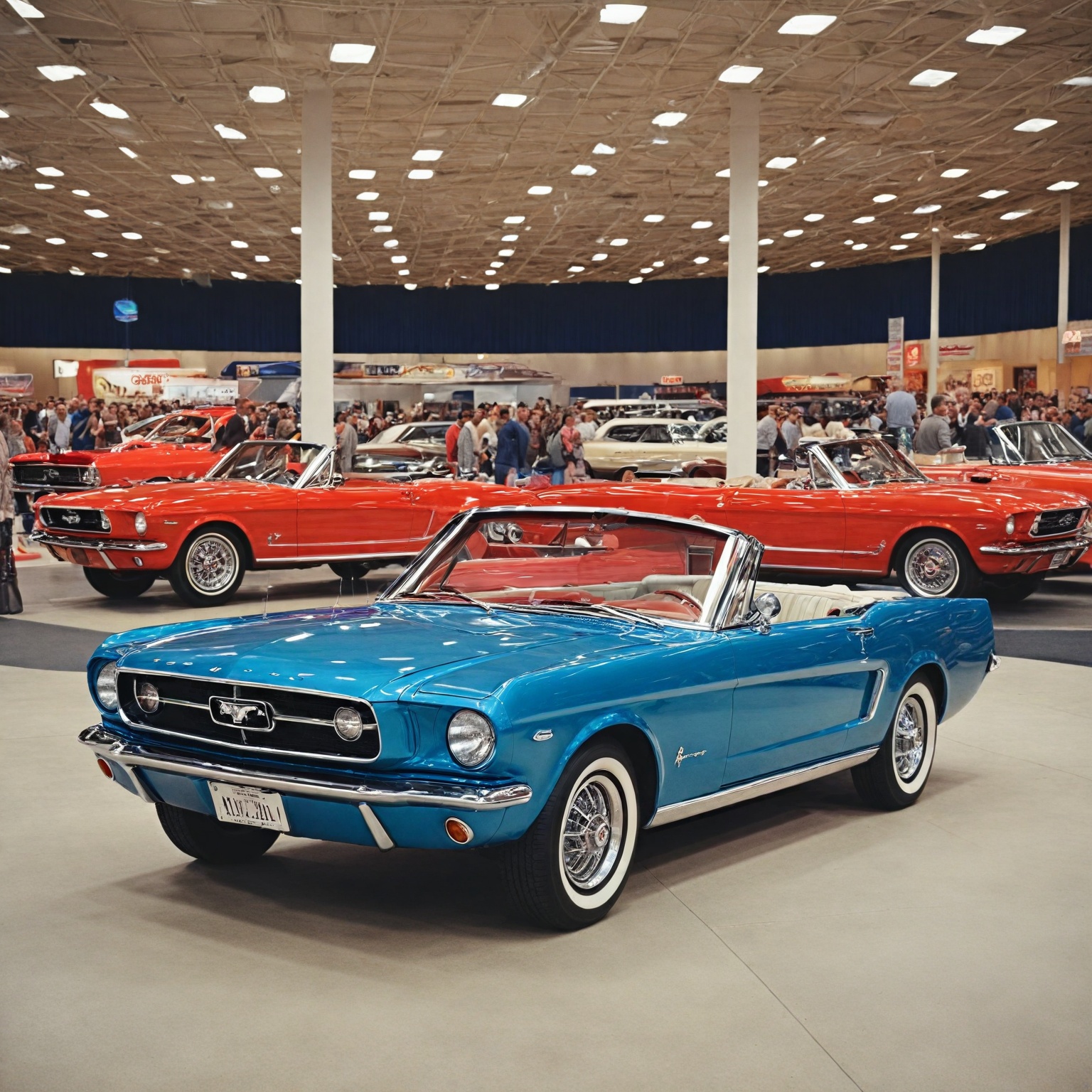
The Ford Mustang made its grand debut on April 14, 1964, during a press event, with the official public unveiling following on April 17, 1964, at the New York World’s Fair. The unveiling took place within the Ford Pavilion, also known as the Wonder Rotunda, which was the largest exhibit at the Fair and a central attraction for visitors. The pavilion showcased the Mustang prominently, allowing attendees to explore its interiors and learn about the car’s numerous available options and accessories.
A highlight of the event was the “Magic Skyway” ride, designed by Walt Disney and his team, which featured a nearly half-mile, twelve-minute journey through a fantasyland depicting millions of years of life on Earth. Visitors had the unique opportunity to ride in an all-new Mustang convertible as part of this attraction, which significantly contributed to the excitement and engagement surrounding the Mustang’s launch. Nearly 15 million visitors experienced the ride, providing widespread exposure for the new model.
The Mustang’s introduction was part of one of the largest automobile and product launches in history. The car had been officially under development since 1961 and was promoted through an extensive marketing campaign that included billboards, television specials, and commercials, culminating in this highly publicized debut at the World’s Fair. Notably, Ford made history by purchasing advertising time across all three major television networks on the day of the unveiling, broadcasting Mustang commercials during popular shows such as Hazel (NBC), Perry Mason (CBS), and The Jimmy Dean Show (ABC). This campaign reached over 29 million viewers and ignited what became known as “Mustang Mania,” as customers flocked to dealerships nationwide to see and test drive the new car.
The New York World’s Fair itself was a major international event, often referred to as the “Universal and International Exposition,” showcasing mid-20th-century American culture and technological innovation. Ford’s Mustang launch was a defining moment of the Fair, exemplifying the company’s innovation and helping cement the Mustang’s place in automotive history. The event’s combination of immersive experiences, extensive media coverage, and strategic marketing contributed to the Mustang’s rapid rise to iconic status.
Marketing and Promotional Strategies
Ford’s advertising agency, J. Walter Thompson, crafted a barrage of creative advertisements that portrayed the Mustang as “a lot of car for the money” and appealed to youthful aspirations with slogans like “Drive a Mustang, get the girls!”. These ads emphasized the Mustang’s affordability and excitement, targeting a wide audience that included young drivers as well as thrifty consumers. One memorable campaign featured the tagline “The Sweetheart of the Supermarket Set,” promoting a six-cylinder Mustang with manual transmission and excellent fuel economy aimed at budget-conscious young mothers.
Moreover, the marketing strategy underscored the Mustang’s versatility and individuality by highlighting the vast customization options available, fostering a sense of belonging to a growing Mustang community while allowing buyers to express their unique tastes.
In addition to traditional advertising, the Mustang benefited significantly from product placement in popular media, which helped it achieve celebrity status during the 1960s. The car’s association with “movie glamour” and appearances in films contributed to a positive public image and boosted sales through embedded marketing efforts. This multifaceted approach combined groundbreaking media strategies with targeted messaging to create a powerful promotional push that firmly established the Mustang as an iconic American automobile.
Features and Specifications
The original Ford Mustang was designed to meet specific goals that included seating for four passengers, bucket seats, a floor-mounted shifter, a weight not exceeding 2,500 pounds (1,100 kg), a length under 180 inches (5 meters), a base price below US$2,500 (equivalent to approximately $25,346 in 2024), and offering multiple power, comfort, and luxury options. The design incorporated innovative elements such as a fixed seat, movable brake and accelerator pedals, and a swing arm steering column to facilitate easier ingress and egress from the vehicle. The car’s distinctive long hood and grille features became signature Mustang design traits.
Under the hood, the Mustang initially came with a choice of engines starting with an inline six-cylinder engine producing 100 horsepower, paired with a three-speed manual transmission. The low-end hardtop model was powered by a “U-code” 170 cubic inch (2.8 L) straight-6 engine shared with the Ford Falcon, retailing for US$2,368 (about $24,008 in 2024). More powerful engine options were available, with the 1965 Fastback Mustang offering up to 272 horsepower, positioning it competitively against contemporaries like the Plymouth Barracuda, which produced 235 horsepower, and the Chevrolet Corvette, which had an output of 425 horsepower.
Standard equipment on early 1965 Mustangs included black front lap belts, a glove box light, and a padded dashboard, reflecting a balance of safety and comfort. Additionally, the use of common components across Ford’s vehicle lineup simplified assembly and repairs, while reducing the need for dealers to maintain extensive spare parts inventories for the new model.
These combined features and specifications helped the Mustang quickly gain popularity, surpassing original sales forecasts and establishing itself as an iconic American sports car.
Impact and Legacy
The Ford Mustang’s debut in 1964 had a profound and lasting impact on the automotive industry and popular culture. It is widely credited with launching the “pony car” segment—compact, affordable, and sporty cars with V-8 engines and 2+2 seating—which sparked a revolution in personal sports cars across the United States. Although it was not the first pony car to market, the Mustang quickly became the defining model of this new class and the only surviving brand from that initial era of competition.
From its initial release, the Mustang captivated the public imagination. Ford’s innovative marketing campaign included a groundbreaking advertising strategy that simultaneously aired commercials across all three major television networks, reaching over 29 million viewers and fueling immediate demand. This “Mustang Mania” translated into exceptional sales, with dealerships selling 22,000 vehicles on the very first day and totaling 417,000 in the first year alone—far exceeding Ford’s original production target of 100,000 vehicles. The car’s appeal extended beyond adult buyers; a notable example of its cultural penetration was the sale of 93,000 pedal-powered children’s Mustangs during the 1964 Christmas season, emphasizing its broad market impact.
The Mustang’s influence was also amplified by effective product placement in popular media, which helped it achieve “celebrity status” during the 1960s. Its appearances in films and television established a glamorous and desirable image, further bolstering its appeal and sales. This media presence created a positive association between the Mustang and an aspirational lifestyle, contributing to its enduring popularity.
Over the decades, the Mustang evolved significantly in design, size, and power while maintaining its core appeal as an accessible, customizable sports car. It expanded from a US-only model to a global phenomenon sold in over 140 markets worldwide, including Europe, Australia, the Middle East, and Asia. Its continuous adaptation and widespread appeal have solidified its position at the top of the sports car market, with over 10 million units sold since its inception and more than one million sold globally since 2015 alone.
Despite intense competition from other muscle and pony cars during its early years, the Mustang carved out a unique place in automotive history. While some muscle cars with larger engines initially outperformed the Mustang on the street, the Mustang’s combination of style, affordability, and cultural cachet ensured its survival and dominance in the market. Today, the Ford Mustang stands as an icon of American automotive heritage, celebrated for its innovation, style, and the passionate community it has inspired.
Subsequent Developments
Following its groundbreaking debut in 1964, the Ford Mustang quickly evolved through a series of significant updates and redesigns that helped cement its place in automotive history. The initial “1964½” models, although officially coded as 1965 models by Ford, featured unique attributes such as the original horn ring bearing the “Ford Falcon” logo, minor engine enhancements, and other design tweaks that distinguished them from later 1965 production cars.
As the Mustang gained popularity, Ford expanded the lineup by introducing the fastback body style in August 1964, alongside the existing hardtop and convertible options. The first generation of Mustangs saw continuous growth in size and engine performance with each successive model year. Notably, the 1967 model represented the first major redesign, featuring a larger, more aggressive body and updated styling cues. This redesign was initiated even while the original Mustang was still enjoying strong sales, reflecting Ford’s commitment to keeping the model fresh and competitive in the growing pony car segment.
Throughout the late 1960s, the Mustang introduced performance-focused trims such as the Boss 302, Boss 429, and Mach 1, which captured the public’s imagination and contributed to the car’s legendary status. These high-performance variants showcased Ford’s engineering prowess and helped the Mustang dominate its market segment.
However, the 1970s and 1980s brought challenges due to changing market conditions, including the energy crisis and tightening emissions regulations. Despite these difficulties, the Mustang maintained its position as a popular choice among sports car enthusiasts, outlasting many competitors who faltered during this period.
In response to evolving consumer preferences and regulatory environments, Ford continued to develop new generations and
The content is provided by Avery Redwood, Gear Shift Zone