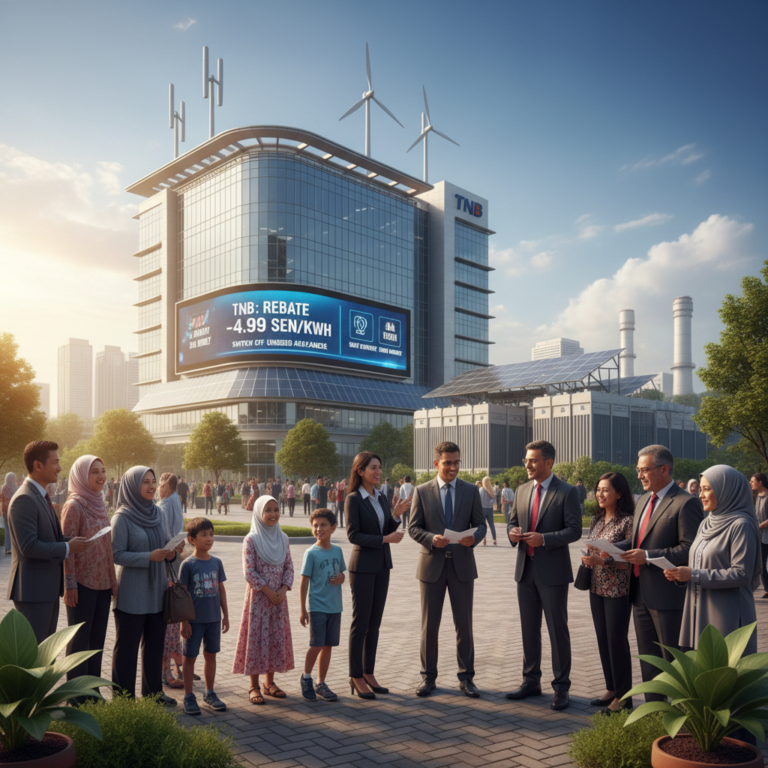
Exciting Update: TNB Sets STs AFA Rate at a Remarkable -6.42 sen/kWh for December 2025!
Summary
The Automatic Fuel Adjustment (AFA) mechanism introduced by Tenaga Nasional Berhad (TNB), Malaysia’s largest electricity utility provider, represents a significant reform in the country’s electricity tariff framework. Replacing the previous Imbalance Cost Pass-Through (ICPT) system starting July 2025, the AFA adjusts electricity tariffs monthly based on fluctuations in global fuel prices and foreign exchange rates, thereby enhancing tariff transparency and cost reflectiveness. The mechanism is capped at a maximum adjustment of 3 sen per kilowatt-hour (kWh) per month unless further changes receive Cabinet approval, balancing market responsiveness with consumer protection.
For December 2025, TNB set the AFA rate at a remarkable –6.42 sen/kWh, effectively providing consumers with a discount on their electricity bills. This negative adjustment is notable as it reduces the generation cost component amid favorable fuel price conditions. Additionally, households consuming 600 kWh or less per month are exempt from the AFA charge, while those under 1,000 kWh benefit from the “Insentif Cekap Tenaga” (Energy Efficiency Incentive), offering discounts of up to 25 sen/kWh to encourage energy conservation. These measures aim to protect low-consumption consumers while promoting efficient energy use.
The introduction of the AFA mechanism aligns with Malaysia’s broader energy policy goals of securing sustainable, reliable, and cost-effective energy supplies. The reform supports TNB’s financial stability and capital expenditure plans under the Fourth Regulatory Period (2025–2027), facilitating investments in diversified energy sources including renewable energy targets set at 20% of the national energy mix by 2025. However, the tariff changes have prompted some concerns from large industrial consumers regarding transparency and the impact of system access charges, highlighting ongoing debates about balancing cost recovery with affordability and renewable energy integration.
Overall, the AFA mechanism and the notable December 2025 negative adjustment mark a pivotal step in Malaysia’s electricity sector transformation, emphasizing dynamic pricing, consumer engagement, and energy efficiency. The reforms underscore the challenges and opportunities in transitioning towards a more sustainable and market-responsive electricity system in Malaysia.
Background
Tenaga Nasional Berhad (TNB), Malaysia’s largest electricity utility provider, plays a crucial role in the nation’s energy landscape, serving as the sole electric utility company in Peninsular Malaysia and the largest publicly listed power company in Southeast Asia. Established in 1949, TNB is committed to delivering reliable and efficient energy services throughout Malaysia, encompassing both urban and rural areas. The company operates an extensive distribution network covering various voltage levels and manages significant power generation assets, including thermal and hydroelectric plants with a combined capacity exceeding 16,000 MW in Peninsular Malaysia.
In line with Malaysia’s national energy policy, which emphasizes ensuring adequate, secure, and cost-effective energy supplies through the development of both non-renewable and renewable energy resources, TNB has been pivotal in advancing the country’s energy diversification and sustainability goals. The government’s initiatives, such as the Small Renewable Energy Programme (SREP) and the target of achieving a 20% renewable energy share in the national energy mix by 2025, reflect the ongoing transformation in the sector to incorporate more clean energy sources.
A significant recent development in Malaysia’s electricity tariff system is the introduction of the Automatic Fuel Adjustment (AFA) mechanism, which replaced the previous Imbalance Cost Pass-Through (ICPT) system starting 1 July 2025. The AFA allows for monthly adjustments of electricity tariffs based on fluctuations in global fuel prices and foreign exchange rates, thereby making tariff changes more dynamic and responsive to market conditions. This mechanism is capped at a maximum surcharge or discount of 3 sen per kWh, with any adjustments beyond this limit requiring cabinet approval. The adoption of AFA forms part of TNB’s Electricity Tariff Restructuring aimed at enhancing transparency and cost-reflectiveness in electricity pricing for consumers across Peninsular Malaysia.
December 2025 STs AFA Rate Update
For the month of December 2025, Tenaga Nasional Berhad (TNB) has set the Strategic Thrusts (STs) Automatic Fuel Adjustment (AFA) rate at a notable -6.42 sen per kWh. This rate effectively acts as a discount on the electricity generation cost component for consumers. The AFA rate is waived entirely for households with total electricity consumption of 600 kWh and below in a month, meaning these users are not subject to the fuel cost adjustment charges.
Under this system, consumers with monthly usage exceeding 1,500 kWh pay a combined charge comprising generation, capacity, and network fees totaling 54.43 sen/kWh, in addition to a retail charge of RM10 and the AFA adjustment (which in December 2025 is a negative value, effectively reducing the bill). For consumption below 1,500 kWh but above 600 kWh, the rate stands at 44.43 sen/kWh plus retail and AFA charges, whereas for 600 kWh and below, the tariff is fixed at 44.43 sen/kWh with retail and AFA fees waived.
Additionally, domestic consumers consuming less than 1,000 kWh per month may qualify for the “Insentif Cekap Tenaga” or “Energy Efficiency Incentive,” which offers discounts relative to consumption, with the maximum incentive being 25 sen per kWh. This further encourages energy-saving behavior among lower consumption households.
The monthly AFA rates are publicly available and are part of TNB’s ongoing efforts to enhance tariff transparency and enable consumers to better estimate their electricity bills through tools such as the TNB Bill Calculator.
Regulatory Framework and Policy Context
Malaysia’s energy regulatory framework is grounded in a series of legislative acts and policies developed since the 1970s. Foundational documents include the 1974 Petroleum Development Act, 1975 National Petroleum Policy, 1980 National Depletion Policy, and subsequent acts related to electricity and gas supply such as the 1990 Electricity Supply Act and 1993 Gas Supply Acts, culminating in the 2001 Energy Commission Act. The Office of the Prime Minister, through the Economic Planning Unit and the Implementation and Coordination Unit, holds overarching responsibility for energy policy, while the Ministry of Energy, Green Technology and Water delineates principal objectives guiding the sector’s development.
The National Energy Policy emphasizes securing adequate, reliable, and cost-effective energy by promoting indigenous resource development—both renewable and non-renewable—and diversifying supply sources domestically and internationally. Key initiatives focus on extending the life of domestic oil and gas reserves while reducing oil dependency by integrating alternative energy sources. Environmental considerations, though historically limited, now require mandatory environmental impact assessments for major energy projects, with compliance enforced through air quality and emission standards. The policy also promotes renewable energy, particularly biomass as the ‘fifth fuel’ under the Fuel Diversification Policy, supported by fiscal incentives like investment tax allowances and the Small Renewable Energy Programme (SREP). Malaysia set a target to increase renewable energy’s share in its energy mix to 20% by 2025, up from 2% in 2018.
In September 2022, the Malaysian government launched the National Energy Policy 2022-2040 (DTN), reaffirming the vision of sustainable energy to support economic development and shared prosperity. This policy introduced four strategic thrusts with corresponding objectives and action plans, including establishing a National Energy Council for integrated planning and coordination.
The electricity tariff framework, primarily managed by Tenaga Nasional Berhad (TNB) as the country’s largest utility, is undergoing significant reforms to align with evolving energy market dynamics and renewable energy goals. Effective 1 July 2025, a new tariff structure replaces the previous Imbalance Cost Pass-Through (ICPT) mechanism with the Automatic Fuel Adjustment (AFA) mechanism, which adjusts tariffs monthly based on actual fuel costs, thereby improving transparency and responsiveness to global energy price fluctuations. The base tariff has been recalibrated to 45.40 sen/kWh for the Fourth Regulatory Period (RP4), spanning 2025 to 2027, reflecting generation, transmission, and service costs more accurately.
The AFA mechanism features a cap on monthly tariff adjustments set at 3 sen per kWh to prevent excessive fluctuations, with any adjustments beyond this requiring Cabinet approval. This approach is expected to enhance TNB’s cash flow stability and strengthen its financial position, supporting the utility’s increased capital expenditure plans under RP4. Alongside tariff reforms, existing energy efficiency incentives remain in place, such as the ‘Insentif Cekap Tenaga’ discount for domestic consumers using less than 1,000 kWh monthly, offering a consumption-relative discount of up to 25 sen/kWh.
The Ministry of Energy Transition and Water Transformation (PETRA) continues to oversee and adjust renewable energy programmes, such as the Green Electricity Tariff (GET) scheme, ensuring alignment with the new tariff regime and maintaining exemptions from the AFA for certain customer categories formerly exempt under ICPT. This regulatory and policy context underpins Malaysia’s ongoing transition towards a more sustainable, efficient, and economically balanced energy sector.
Impact Analysis
The implementation of the Automatic Fuel Adjustment (AFA) mechanism marks a significant shift in Malaysia’s electricity tariff framework starting from July 2025. This change introduces monthly tariff adjustments based on prevailing fuel prices and exchange rates, capped at 3 sen/kWh per month unless further approval is granted, enhancing the responsiveness and accuracy of electricity pricing to market conditions.
The AFA rate of -6.42 sen/kWh for December 2025, representing a discount to consumers, is a remarkable development. This negative rate effectively lowers electricity costs for users, particularly benefiting domestic consumers who consume less than 1,000 kWh monthly. These consumers are also eligible for the ‘Insentif Cekap Tenaga’ or ‘Energy Efficiency Incentive,’ which offers a maximum discount of 25 sen/kWh relative to consumption, incentivizing energy conservation and efficiency.
From a tariff structure perspective, the base tariff has been revised to 45.40 sen/kWh under Regulatory Period 4 (RP4), effective from July 1, 2025, to December 31, 2027. The new bill composition includes five components: energy charge, capacity charge, network charge, retail service charge, and the AFA. This breakdown aims to more fairly allocate fixed and variable costs, ensuring consumers contribute equitably to infrastructure and network investments by Tenaga Nasional Berhad (TNB).
Financially, the new tariff structure and the monthly AFA adjustments are expected to stabilize and enhance TNB’s cash flow and balance sheet. Analysts have noted the potential earnings upside as TNB advances with substantial capital expenditure plans totaling RM16.3 billion, which are supported by a higher Regulated Asset Base (RAB) under RP4 and RP5 (2025–2030). The alignment of tariff charges with actual system costs, particularly through increased demand charges and reduced energy charges, strengthens TNB’s ability to recover costs timely and sustainably.
For consumers, particularly domestic users, these changes provide greater transparency and fairness in electricity billing. For example, a household consuming 400 kWh per month would see a reduced bill under RP4 compared to RP3, reflecting the elimination of the previous biannual fuel surcharge and the introduction of the monthly AFA rate. However, concerns remain among some large consumers, such as data centres, regarding the transparency and high level of system access charges under the current Cost Reflective Electricity Tariff (CRESS) scheme, which may impact their procurement of renewable energy directly.
Responses and Public Reception
The introduction of the Automatic Fuel Adjustment (AFA) mechanism by Tenaga Nasional Berhad (TNB) in July 2025 has been met with a mixture of cautious optimism and calls for increased consumer education. The AFA system aims to provide greater transparency and predictability in electricity billing by reflecting monthly changes in fuel prices and exchange rates more accurately.
Consumers, particularly domestic users consuming less than 1,000 kWh per month, continue to benefit from the ‘Insentif Cekap Tenaga’ or Energy Efficiency Incentive, which offers a discount up to 25 sen/kWh based on their usage, thus encouraging energy conservation. This incentive has been positively received as it helps to mitigate the impact of fluctuating tariffs on low-consumption households.
The commercial and industrial sectors have experienced tariff adjustments reflecting the government’s efforts to balance rising global energy costs with a transition towards renewable energy. While businesses have welcomed the improved predictability in budgeting afforded by the monthly tariff updates, some have expressed concerns about the overall cost implications in the short term.
Energy market experts emphasize the importance of consumer understanding and engagement with the new tariff framework. As the energy landscape grows more complex, fostering trust and enabling informed decision-making are seen as critical steps towards a resilient, efficient, and cleaner power system in Malaysia. The proactive communication of AFA rates, including rebates such as the remarkable –6.42 sen/kWh rate announced for December 2025, has contributed to increased public awareness and a generally positive reception of the reforms.
Future Outlook
Tenaga Nasional Berhad (TNB) is positioned for potential earnings growth driven by its substantial RM16.3 billion contingent capital expenditure plan. Analysts, including HLIB, maintain a “BUY” recommendation with an unchanged discounted cash flow (DCF) target price of RM16.20, reflecting anticipated benefits from an increased Regulated Asset Base (RAB) commencing in 2025 under the Fourth and Fifth Regulatory Periods (RP4-5, 2025–2030). This expansion is supported by new tenders for gas power plants and renewable energy projects, signaling a strategic shift towards a more diversified energy portfolio.
A key component of the future tariff structure is the implementation of the Automatic Fuel Adjustment (AFA) system, which links electricity tariffs to global crude oil and fuel price fluctuations. Starting from July 2025, tariffs will be adjusted monthly rather than biannually, offering a more dynamic and market-reflective pricing mechanism. The Energy Commission (EC) has projected that base electricity rates may decrease by up to 19% under this new framework during RP4 (2025–2027). However, to protect consumers and ensure stability, monthly adjustments are capped at 3 sen per kWh, with any excess requiring Cabinet approval.
This monthly adjustment model is expected to provide greater predictability and fairness. Low-consumption households (using 600 kWh or less) will benefit from protections against sudden fluctuations, while businesses will gain enhanced visibility for budgeting and planning. The more frequent and smaller adjustments should empower consumers to better manage their energy consumption and costs.
On a broader scale, Malaysia’s energy policy framework continues to evolve in alignment with national objectives to secure adequate, cost-effective, and sustainable energy supplies. Efforts emphasize diversification from oil dependence and the promotion of renewable energy, particularly biomass, designated as the ‘fifth fuel’ under the Fuel Diversification Policy. Fiscal incentives such as investment tax allowances and the Small Renewable Energy Programme (SREP) aim to encourage the integration of small-scale renewable power generation into the national grid. By 2025, Malaysia targets 20% renewable energy in its energy mix, a significant increase from just 2% in 2018.
As the energy sector undergoes this major transition, clear communication and consumer engagement will be critical. Building trust and facilitating informed energy choices are essential for the success of tariff reforms and for establishing a resilient, efficient, and cleaner power system in Malaysia.
The content is provided by Avery Redwood, Gear Shift Zone