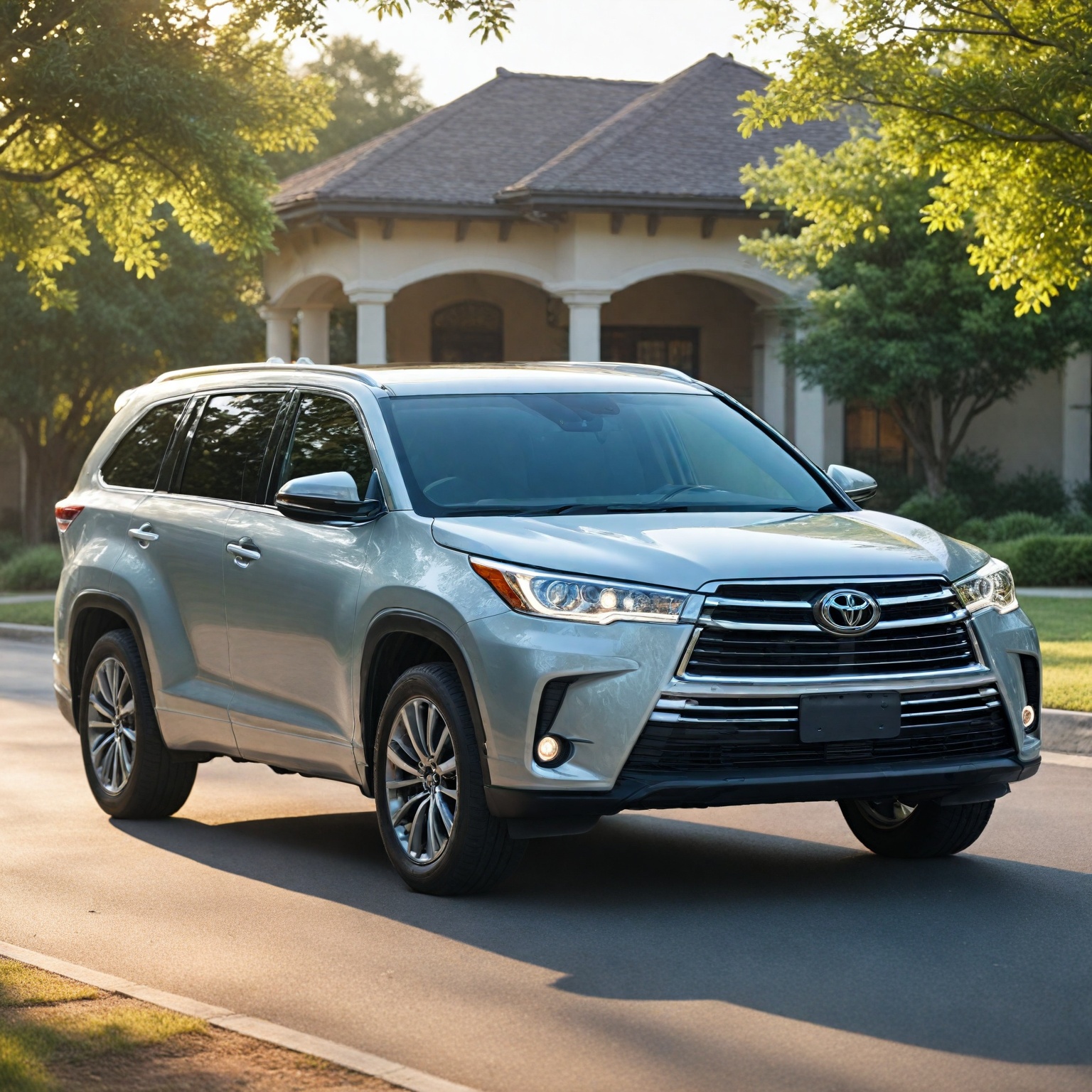
Highlights
- The 2025 Kluger and Highlander showcase Toyota's strategic adaptability to meet diverse regional demands in the SUV market.
- Both models prioritize family-oriented features and advanced safety technologies, enhancing their appeal to buyers across various markets.
- Explore the differences between the Kluger and Highlander to find the perfect SUV tailored to your family's needs.
“`html
Summary
The 2025 Toyota Kluger and Highlander are mid-size SUVs produced by Toyota that share the same underlying platform and design but are marketed under different names depending on the region. Known as the Kluger in Australia and Japan and as the Highlander in North America and most other markets, the naming distinction arises from trademark conflicts, with Hyundai owning the rights to the “Highlander” name in Australia since 1999. Both models target family-oriented buyers seeking versatile, spacious, and technologically advanced SUVs, with an emphasis on safety, comfort, and hybrid powertrain options. Manufactured primarily at Toyota Motor Manufacturing Indiana (TMMI) for the North American Highlander since 2010, the production of these SUVs reflects Toyota’s global strategy of regional adaptation and consolidation. The Kluger, imported from the United States to Australia, features seven-seat configurations with family-friendly amenities, while the Highlander offers a broader range of trims and powertrains tailored to North American preferences, including a recently introduced turbocharged engine replacing the previous V6. Both vehicles emphasize advanced safety technologies, including comprehensive airbag coverage and Toyota’s latest driver assistance suites, contributing to strong safety ratings in their respective markets. Despite their similarities, the Kluger and Highlander have experienced divergent market receptions. The Kluger faces challenges in Australia’s competitive SUV segment, with sales declining by nearly 25% through April 2025 amid Toyota’s shift toward petrol-hybrid models and increasing competition from rugged body-on-frame SUVs like the Ford Everest and Isuzu MU-X. Conversely, the Highlander continues to perform well in North America, supported by Toyota’s expansion of the lineup with variants such as the larger Grand Highlander, reflecting the brand’s strategy to diversify offerings based on regional demand. Overall, the 2025 Kluger and Highlander exemplify Toyota’s ability to tailor a single SUV platform to meet diverse regulatory, market, and consumer needs across different regions. While both models prioritize family-friendly design, fuel efficiency through hybrid technology, and advanced safety features, their distinct market positions and regional adaptations highlight the complexities and competitive challenges within the global mid-size SUV segment.
Overview
The Toyota Kluger and Highlander are essentially the same mid-size SUV model marketed under different names depending on the region. In Australia and Japan, the vehicle is known as the Kluger, while in North America and most other markets it is sold as the Highlander. This naming distinction is largely due to trademark conflicts; specifically, Hyundai has held the rights to the “Highlander” name in Australia since December 1999, preventing Toyota from using it there. Production of the Highlander shifted significantly over time. Since the 2010 model year, the majority of Highlanders for the North American market have been manufactured at Toyota Motor Manufacturing Indiana (TMMI) in Princeton, Indiana, replacing production previously dedicated to the Tundra pickup. Initially, only gasoline-powered models were produced at TMMI from October 2009, while hybrid versions were imported from Japan. However, with the introduction of the third generation (XU50), nearly all Highlander production outside China was consolidated at TMMI. The Kluger name has a unique origin, deriving from the German word “klug,” meaning smart or clever, with “klüger” translating to “more clever.” It is also notable that the Kluger shares its platform with the Lexus RX and Toyota Harrier, underlining its connection to Toyota’s broader SUV family. The model’s adaptation to different markets exemplifies Toyota’s strategic flexibility, allowing the brand to tailor its products and branding to local conditions and legal constraints, which has been viewed as a potentially successful approach in regions like Australia. Toyota regularly updates model details such as specifications, pricing, colors, and materials, sometimes discontinuing or altering these without prior notice. For comprehensive information, customers are advised to refer to the applicable Warranty and Maintenance Guide.
Design and Features
The 2025 Toyota Kluger and Highlander share a contemporary design language that balances sophistication and practicality, tailored to meet the needs of modern families and drivers seeking versatility. The Kluger features a spacious and functional interior focused on comfort and convenience. Although it visually suggests a capacity for eight seats, Australian Kluger models are limited to seven, with the third row best suited for children or smaller adults due to its elevated floor and upright backrest. The second row is adjustable to increase third-row legroom and offers a flat bench with a flat floor design, improving middle passenger comfort. Amenities include armrests, cupholders, roof-mounted ventilation, a fold-down centre armrest with cupholders, a third zone of climate control with roof vents, extra USB charging ports, and sliding and reclining functionality for the second row. Despite the expansive glasshouse enhancing outward visibility, the third row provides a modest cargo space of 241 litres when fully occupied, comparable to smaller vehicles. The front seats are well-appointed, featuring eight-way power adjustments, heated and ventilated options, and power lumbar support for the driver in higher trims. The instrument cluster in lower trims is analog with a central display but is less modern compared to the Grande variant’s digital panel. The cabin materials are of high quality, often including leather seating depending on trim, and the overall interior design prioritizes usability over flashiness. Safety and convenience technology includes front and rear parking sensors, reversing camera, and Toyota Connected Services with one year of complimentary access. The Kluger’s driver assistance suite incorporates features such as Pre-Collision Safety System with Pedestrian and Cyclist Detection, Lane Trace Assist, and Parking Support Brake to enhance safety and driver confidence. The Highlander also presents refreshed exterior styling for 2025, featuring updated grille designs, new alloy wheel options, and new exterior colors such as Heavy Metal on select trims. Inside, it boasts a larger standard touchscreen for improved connectivity and usability, along with the expanded availability of Toyota’s Safety Sense™ 3.0 suite. All Highlander trims deliver 265 horsepower with fuel economy ratings of approximately 24 MPG combined (21 city / 28 highway). The Highlander Hybrid version offers an estimated 35 MPG, delivering a smooth and confident ride. Interior features and technology focus on a balance between bold design and everyday elegance, appealing to drivers who desire style and practicality. The safety suite includes Toyota Safety Sense™ 2.5+ in earlier models and Safety Sense™ 3.0 in the latest versions. New trims introduced for 2025 include a more affordable LE trim below the XLE and a Hybrid Nightshade trim featuring blacked-out exterior elements and the 2.5-liter hybrid powertrain shared with higher trims. The Highlander emphasizes versatility and modern technology integration throughout its range, targeting a broad spectrum of customers looking for a family SUV with refined features and advanced driver assistance systems.
Performance
The 2025 Toyota Kluger emphasizes low-speed response and delivers a driving experience consistent with a large family-oriented Toyota SUV. It offers predictable, conservative, and safe handling with light steering, which aids urban maneuvering. Visibility is enhanced by large windows and a boxy design, contributing to an overall comfortable driving feel. While performance remains adequate across the speed range, the Kluger prioritizes ride quality and comfort over sporty driving dynamics. The Kluger’s hybrid powertrain variant boasts a fuel economy of 5.6 L/100 km and a power output of 184 kW (approximately 247 horsepower) with 242 Nm of torque. The hybrid system allows the vehicle to switch to electric mode when coasting or under minimal throttle, improving efficiency, particularly in urban and mixed driving conditions. The suspension setup supports a smooth ride, comparable to Toyota’s most refined models, although the petrol engine can produce a somewhat uninspiring sound when engaged, especially in conjunction with the continuously variable transmission (CVT). In contrast, the 2025 Toyota Highlander offers two primary powertrain options. The base model replaces the previous 3.5-liter V6 with a smaller 2.4-liter turbocharged inline-four engine that generates 265 horsepower and 310 lb-ft (approximately 420 Nm) of torque. Although the turbo four-cylinder produces 30 horsepower less than the outgoing V6, its increased torque at lower rpm results in improved daily driving performance and brisk acceleration, with 0 to 60 mph times around 7.4 seconds for the all-wheel-drive variant. The turbocharged engine delivers strong low-end grunt, making city driving effortless, but some reviewers have criticized its noise profile, describing it as louder and less refined compared to the smooth V6 it replaced. The Highlander is equipped with an independent front suspension and a double-wishbone rear suspension, which contribute to a smooth and comfortable ride suitable for family use and longer trips. Drivetrain options include standard front-wheel drive and available all-wheel drive, which is standard on higher trims like XSE and Platinum. The high torque output from the turbocharged engine combined with these drivetrain options enhances traction and drivability across various conditions.
Safety
The 2025 Toyota Kluger and Highlander both prioritize occupant safety through a comprehensive suite of advanced safety technologies and strong crash protection ratings. The Kluger holds a five-star ANCAP safety rating based on 2021 testing, reflecting its robust passive and active safety features designed to protect all occupants, including vulnerable road users. It is equipped with up to seven airbags, including driver and passenger airbags, driver’s knee airbag, side-impact airbags, and curtain shield airbags extending to the third-row seats. Active safety technologies such as front and rear parking sensors, a reversing camera, and parking support brake enhance situational awareness and assist in collision avoidance during low-speed maneuvers. The Kluger’s Pre-Collision Safety System (PCS) features pedestrian and daylight cyclist detection, which can warn the driver and automatically apply brakes to mitigate or avoid collisions. Additionally, Lane Trace Assist helps keep the vehicle centered within its lane by applying partial steering force when necessary. These features underline Toyota’s commitment to integrating intelligent driver assistance technologies aimed at reducing crash severity or preventing accidents altogether. Similarly, the 2025 Highlander is equipped with Toyota Safety Sense™ 2.5+, an advanced driver-assistance suite standard across all trims. This includes adaptive cruise control, lane departure alert with lane tracing assist, and automatic emergency braking with pedestrian detection, contributing to the vehicle’s strong safety profile. The Highlander has also earned positive crashworthiness ratings, such as the IIHS “Good” rating in the small overlap front crash test for the 2024 Grand Highlander variant. Together, both the Kluger and Highlander leverage a blend of structural integrity, extensive airbag coverage, and cutting-edge safety technologies to deliver high levels of protection for drivers, passengers, and other road users in the 2025 model year.
Pricing and Trim Levels
The 2025 Toyota Highlander lineup features several trim variations, all powered by a 265-horsepower engine. For the 2026 model year, Toyota discontinued the LE trim, and all remaining trims come standard with all-wheel drive (AWD), reflecting a shift towards enhanced performance and safety across the range. Fuel economy for all trim levels is consistent, rated at 24 miles per gallon (MPG) combined, with 21 MPG in the city and 28 MPG on the highway. In contrast, the Toyota Kluger, which shares many characteristics with the Highlander but is marketed primarily in Australia and select international markets, continues to cater to family buyers with its seven-seat configuration. While specific trim details and pricing for the Kluger vary by region, it maintains a strong presence in Australia despite a 24.8% decline in sales to 2,125 units by April 2025. This drop coincides with Toyota Australia’s strategy to phase out petrol-only models in favor of petrol-hybrid powertrains across several lines, including the Kluger. The Highlander remains predominantly a North American model, with its trim levels and pricing structured to meet the preferences of that market. Meanwhile, the Kluger adapts to the demands of Australian consumers, reflecting Toyota’s approach to tailoring its SUV offerings to different regions. The introduction of the larger Grand Highlander in North America in early 2023 further exemplifies Toyota’s strategy to diversify trim and model options according to market needs.
Market Comparison
The 2025 Toyota Kluger and Highlander both target family-oriented SUV buyers, but their market presence and adaptability vary notably across regions. The Highlander has demonstrated potential for success in Australia, with the brand adapting products to fit different market demands and preferences. In contrast, the Kluger, which is essentially the Australian-market equivalent of the Highlander, exhibits features and configurations tailored specifically for local consumers, although models, prices, colors, and equipment can vary or be discontinued without notice depending on regional factors such as state-specific taxes and regulations. In terms of design and comfort, the Kluger Grande offers premium interior options including power-adjustable heated front seats with multiple settings, memory driver’s seat, and ventilated seating, positioning it as a discerning family vehicle. The vehicle’s driving dynamics emphasize low-speed responsiveness and predictable, safe handling, which align with expectations for a large family SUV in the Toyota range. However, some critiques highlight the Kluger’s outdated entertainment technology—limited to composite video inputs without HDMI—and other features such as the absence of a proper moon roof or rain-sensing wipers, which are present in U.S. models. Safety remains a strong point for the Kluger, equipped with a comprehensive airbag system including driver’s knee and curtain shield airbags extending to the third row, along with advanced parking sensors, reversing camera, and parking support brake features designed to enhance occupant protection and collision avoidance. These attributes underscore Toyota’s commitment to safety across its SUV offerings. Pricing for the 2025 Kluger reflects a significant increase compared to previous generations, with entry-level models starting at $54,420 before on-road costs and top variants reaching up to $83,535, a rise influenced by discontinuation of petrol variants and market adjustments in 2024. The Kluger’s spacious interior, especially in the second row, includes family-friendly amenities such as ISOFIX points, a flat bench seat for better middle passenger comfort, climate control zones, USB charging, and sliding/reclining seat options, reinforcing its suitability for family use.
Market Reception and Sales Performance
The 2025 Toyota Kluger has experienced mixed market reception, particularly in Australia where it competes within a crowded SUV segment. Despite its longstanding presence since 2003 and reputation as a reliable family seven-seat SUV, recent sales figures show a decline. Up to the end of April 2025, Australian Kluger sales fell by 24.8 percent to 2,125 units, which is modest compared to Toyota’s more popular SUVs like the LandCruiser, Prado, and RAV4. This decline coincides with Toyota Australia’s strategic move to discontinue petrol-only versions of several models, including the Kluger, shifting exclusively to petrol-hybrid powertrains across the range. Critical reception of the Kluger’s interior has been notably positive, with reviewers expressing genuine admiration, especially when contrasted with other Toyota SUVs such as the Fortuner. The luxurious features, including leather-trimmed heated and ventilated front seats and heated second-row seats, contribute to its appeal as a family-oriented vehicle. Expert reviews have been favorable overall, with CarsGuide rating the 2025 Kluger at 8.6 out of 10, highlighting its strengths in comfort and practicality. In contrast, the Highlander, the Kluger’s counterpart primarily sold in North America, benefits from adaptations suited to its regional market, which some analysts believe could also translate to success in Australia. The brand’s ability to tailor its products to meet different market preferences is seen as a fascinating strategic advantage. Furthermore, the introduction of the larger Grand Highlander variant in North America in 2023 demonstrates Toyota’s commitment to diversifying the Highlander line to appeal to varying consumer needs, featuring significant changes in size and styling despite sharing the same platform.
Competitors and Market Positioning
The Toyota Kluger and Highlander share many similarities but target different regional markets and face distinct competitive landscapes. The Highlander is primarily sold in North America, while the Kluger
Manufacturing and Production
The 2025 Toyota Kluger and Highlander share a complex manufacturing and production history reflective of Toyota’s global strategy. The Highlander has been produced at Toyota Motor Manufacturing Indiana (TMMI) in Princeton, Indiana, since the 2010 model year for the majority of the North American market. Initially, only gasoline engine models were assembled at TMMI starting in October 2009, while hybrid versions continued to be imported from Japan until the launch of the third-generation XU50. From that generation onward, all Highlander production—except for models destined for China—has been consolidated at the TMMI facility. In contrast, the Kluger, which is the name used in Australia for the Highlander, was launched in its new generation in August 2007 and continues to be sourced entirely from the United States. The entire range of Klugers currently available in Australia are hybrid and equipped with all-wheel drive, distinguishing them in a segment largely dominated by body-on-frame SUVs with seven-seat capacity. This production and sourcing approach contrasts with competitors like the Ford Everest and Isuzu MU-X, which employ ladder-frame construction. It is also important to note that Toyota Australia advises that vehicle specifications, features, and availability may change without notice, and the information provided is accurate as of April 2025. This reflects Toyota’s commitment to updating product details as necessary while recognizing regional differences in production and supply chains.
“`
The content is provided by Harper Eastwood, Gear Shift Zone